- July 27, 2026
- Madre Janus
The Bank of Baroda data breach has emerged as a significant cybersecurity incident involving one of India’s largest public sector banks, after a threat actor claimed to have stolen and leaked approximately 1 TB of data.
But what actually happened to Bank of Baroda? How did the attackers allegedly gain access? What customer information may have been exposed? And how large could the financial and business impact become?
The incident has been claimed by a cyber-extortion group known as Triple X, which reportedly alleged that weak credentials provided the initial access. Independent analysis of the leaked material indicates that the exposed files may include customer personally identifiable information (PII), KYC documents, Aadhaar and PAN information, account and loan-related records, as well as sensitive internal bank documents.
However, several crucial details surrounding the Bank of Baroda data breach remain under investigation. A claimed 1 TB leak does not mean 1 TB of customer PII was exposed, and there is currently no verified figure for direct financial losses resulting from the cyber incident.
Here is what is currently known, what remains unconfirmed, and what the incident means for cybersecurity in the Indian banking sector.

What Happened in the Bank of Baroda Data Breach?
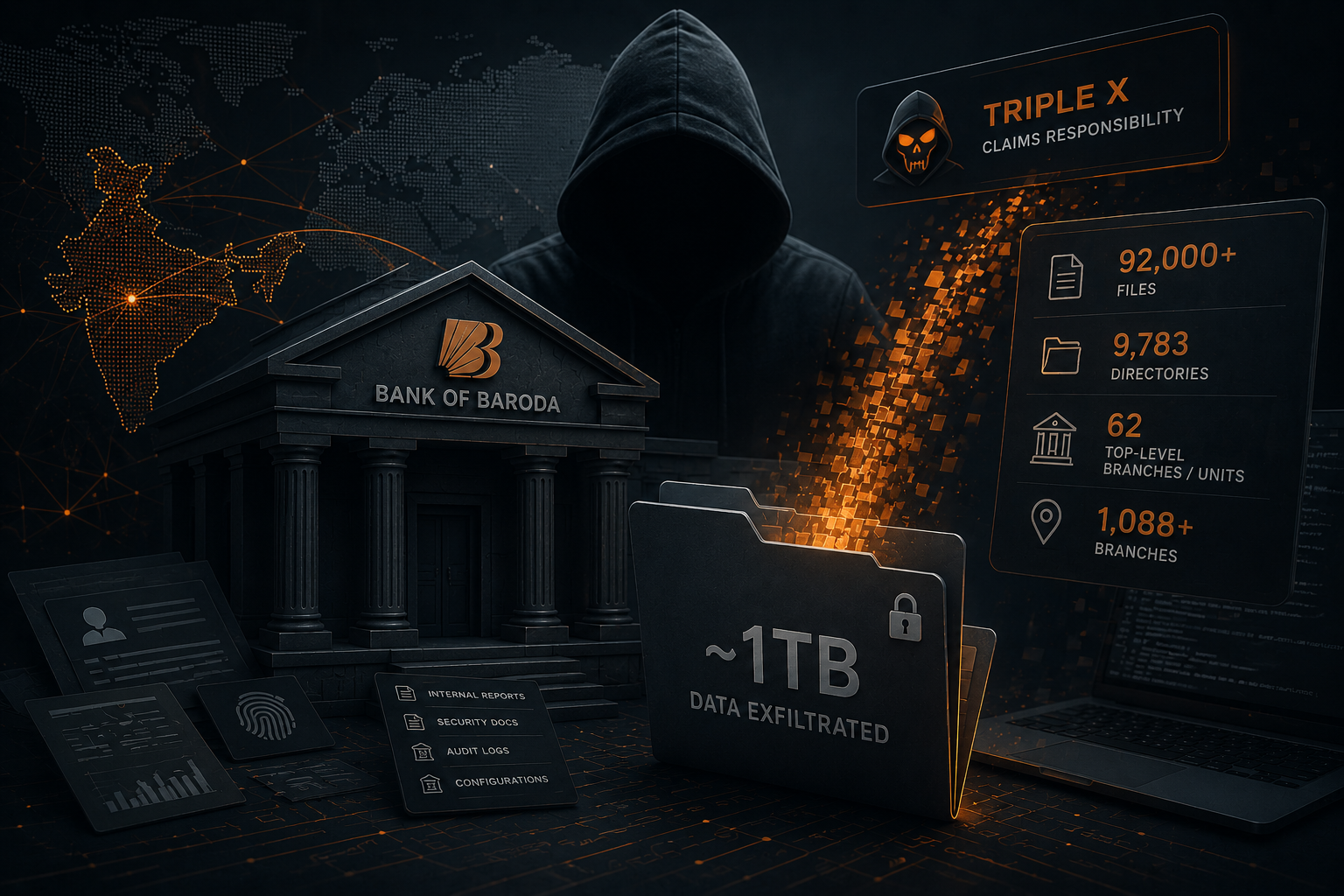
A threat actor identifying itself as Triple X claimed responsibility for compromising Bank of Baroda and exfiltrating approximately 1 TB of data.
The incident came into wider public attention in late July 2026 after reports and independent researchers began examining the allegedly leaked dataset.
Analysis by CashlessConsumer has reported observing more than 92,000 files, 9,783 directories, 62 top-level branches or units, and data associated with more than 1,088 branches within the material under examination.
The reported contents suggest that the incident may extend beyond a conventional customer database leak.
Alongside customer information, the exposed material reportedly contains internal operational and security-related documents. This potentially makes the incident both a data privacy event and an enterprise cybersecurity incident.
At the time of writing, important aspects of the attack, including the complete intrusion path and final number of individuals affected, have not been publicly established.
Who Was Behind the Bank of Baroda Data Breach?
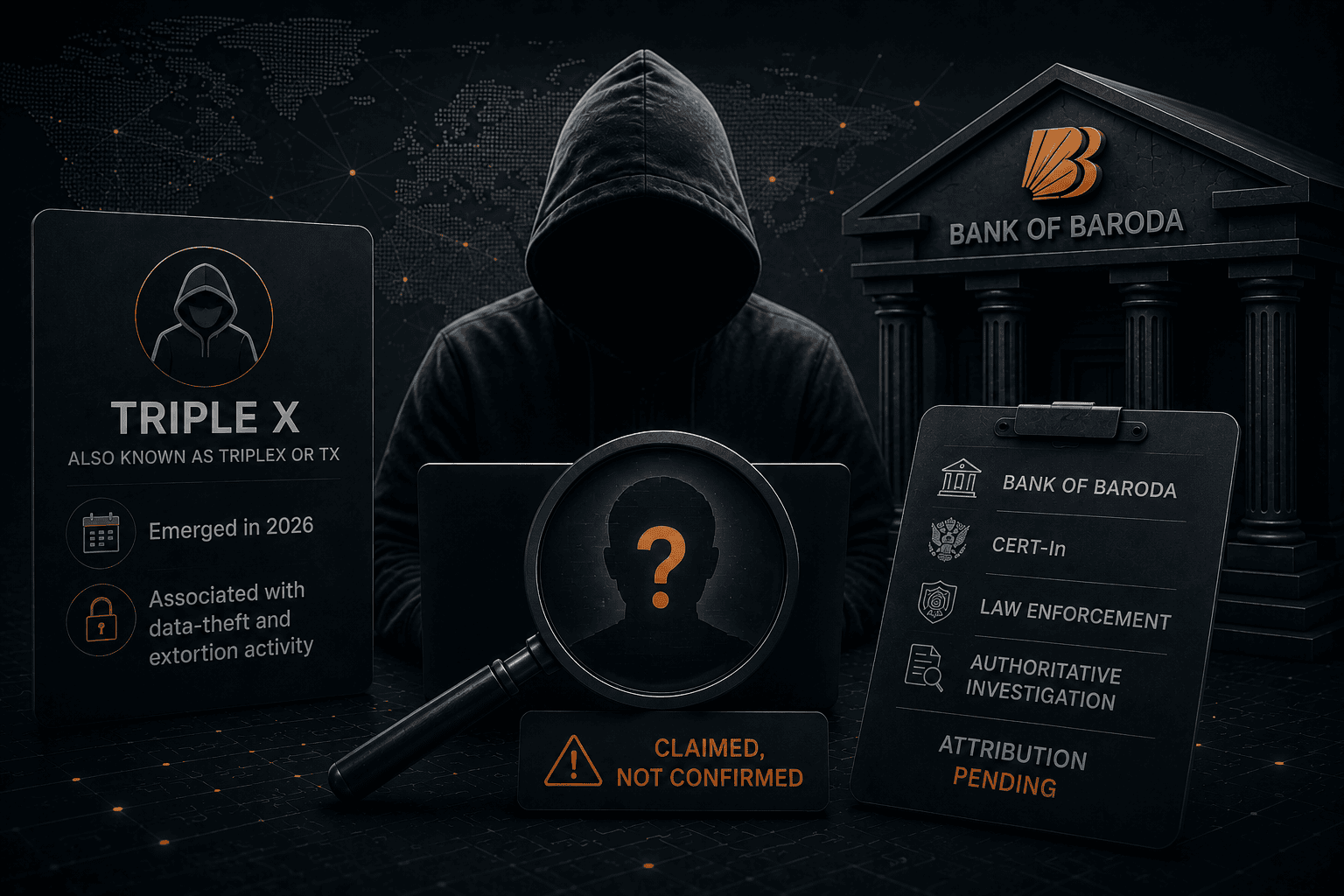
The cyber-extortion group Triple X, also referred to in some reporting as TripleX or TX, has claimed responsibility for the incident.
The group reportedly emerged in 2026 and has been associated with data-theft and extortion activity.
However, a threat actor claiming responsibility is not the same as confirmed attribution.
Until Bank of Baroda, CERT-In, law enforcement, or another authoritative investigation establishes attribution, Triple X should be described as the group claiming responsibility, rather than conclusively as the attacker responsible for the breach.
This distinction is especially important while the incident remains under investigation.
How Did the Bank of Baroda Data Breach Happen?
One of the most consequential claims surrounding the incident is that the attack may have begun with something remarkably ordinary: weak or compromised credentials.
Triple X reportedly claimed that a weak password enabled its initial access.
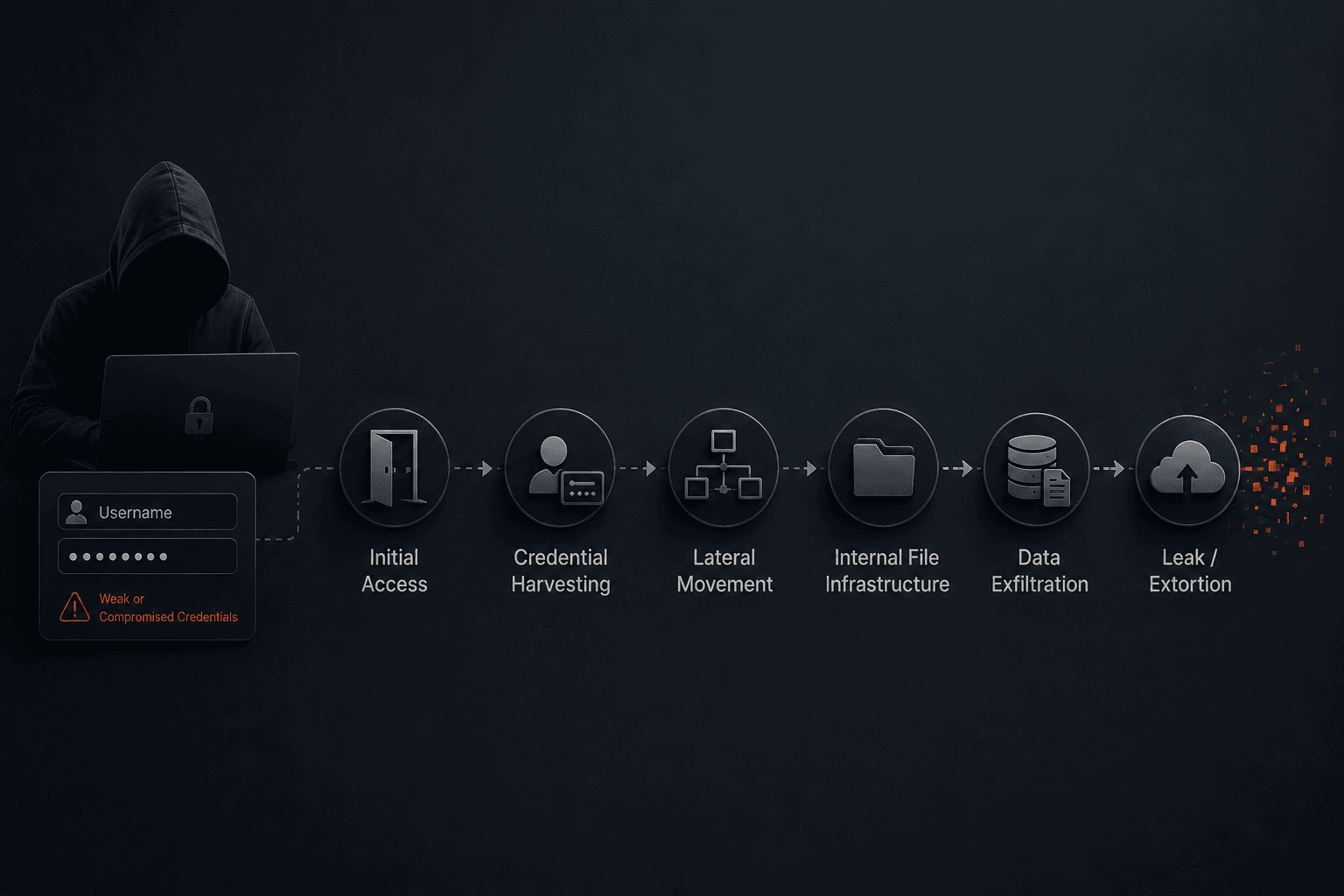
Independent analysis has suggested a possible attack path involving compromised credentials, access to an externally reachable service or environment, credential harvesting, lateral movement across internal systems, access to file-sharing or SharePoint infrastructure, and eventual large-scale data exfiltration.
A simplified potential attack chain is:
Weak or compromised credentials → Initial access → Credential harvesting → Lateral movement → Internal file infrastructure → Data exfiltration → Leak/extortion
The precise initial access vector has not been independently established publicly, so claims about a specific VPN, RDP service or other system should be treated as hypotheses rather than confirmed facts.
What matters from a defensive perspective is the potential escalation.
A compromised credential should ideally represent a contained security event. If attackers can use one identity to discover additional credentials, move laterally, access sensitive repositories and exfiltrate large volumes of information, the incident becomes a question of identity security, segmentation, privilege management, monitoring and data-loss controls, not simply password strength.
What Data Was Leaked in the Bank of Baroda Breach?
The reported scale of the Bank of Baroda data leak is substantial.
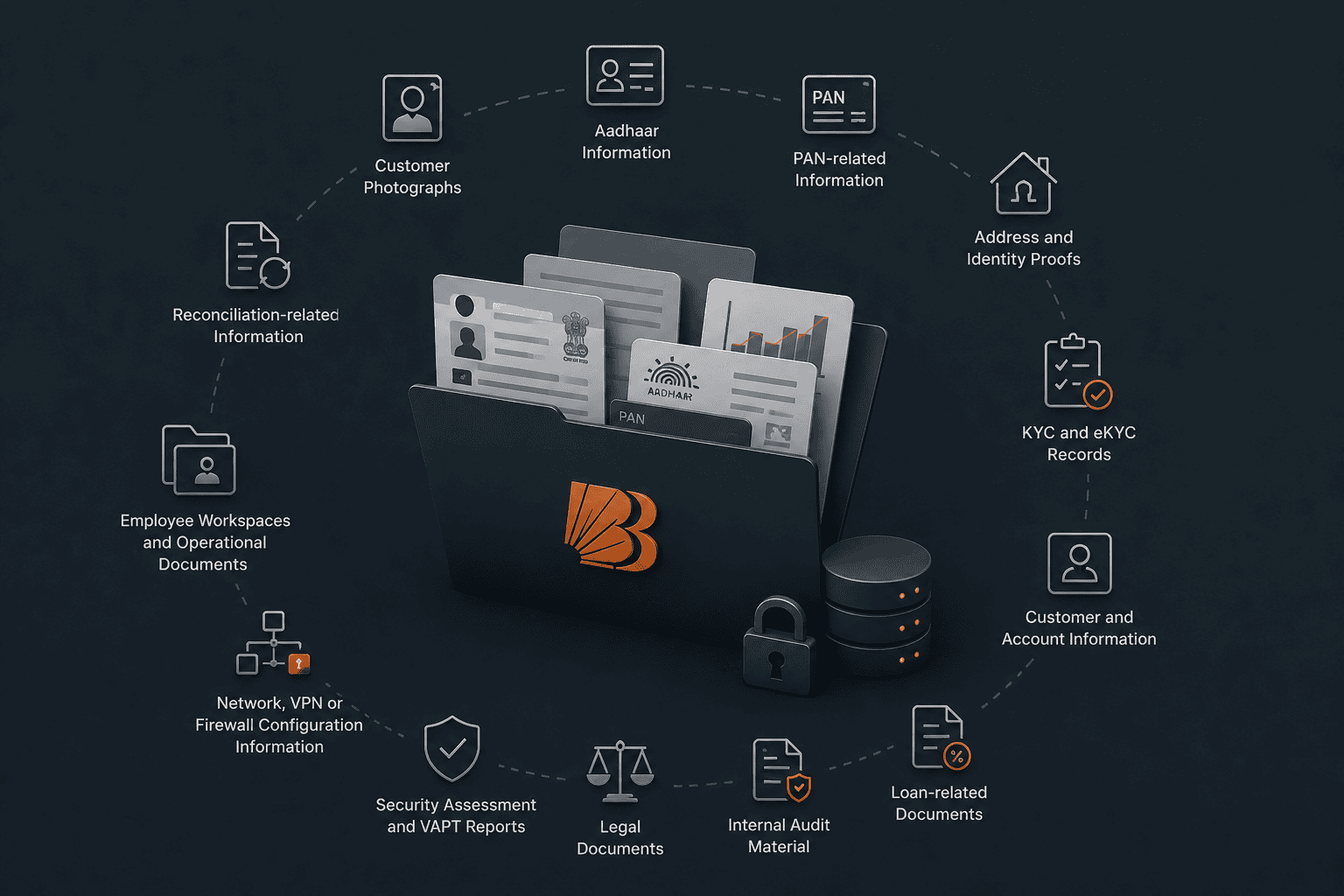
Independent analysis of the material has reportedly identified customer and internal information including:
- Aadhaar information
- PAN-related information
- Customer photographs
- Address and identity proofs
- KYC and eKYC records
- Customer and account-related information
- Loan-related documents
- Internal audit material
- Legal documents
- Security assessment and VAPT reports
- Network, VPN or firewall-related configuration information
- Employee workspaces and operational documents
- Reconciliation-related information
Other reporting has also indicated that the dataset may contain information relating to savings and current accounts, NetBanking users, NRI and corporate banking, customer support, branches and ATMs.
The presence of identity documents is particularly concerning because PII exposure can create risks that continue long after the original cybersecurity incident has been contained.
Was 1 TB of Bank of Baroda Customer PII Leaked?
Not necessarily.
This distinction is important.
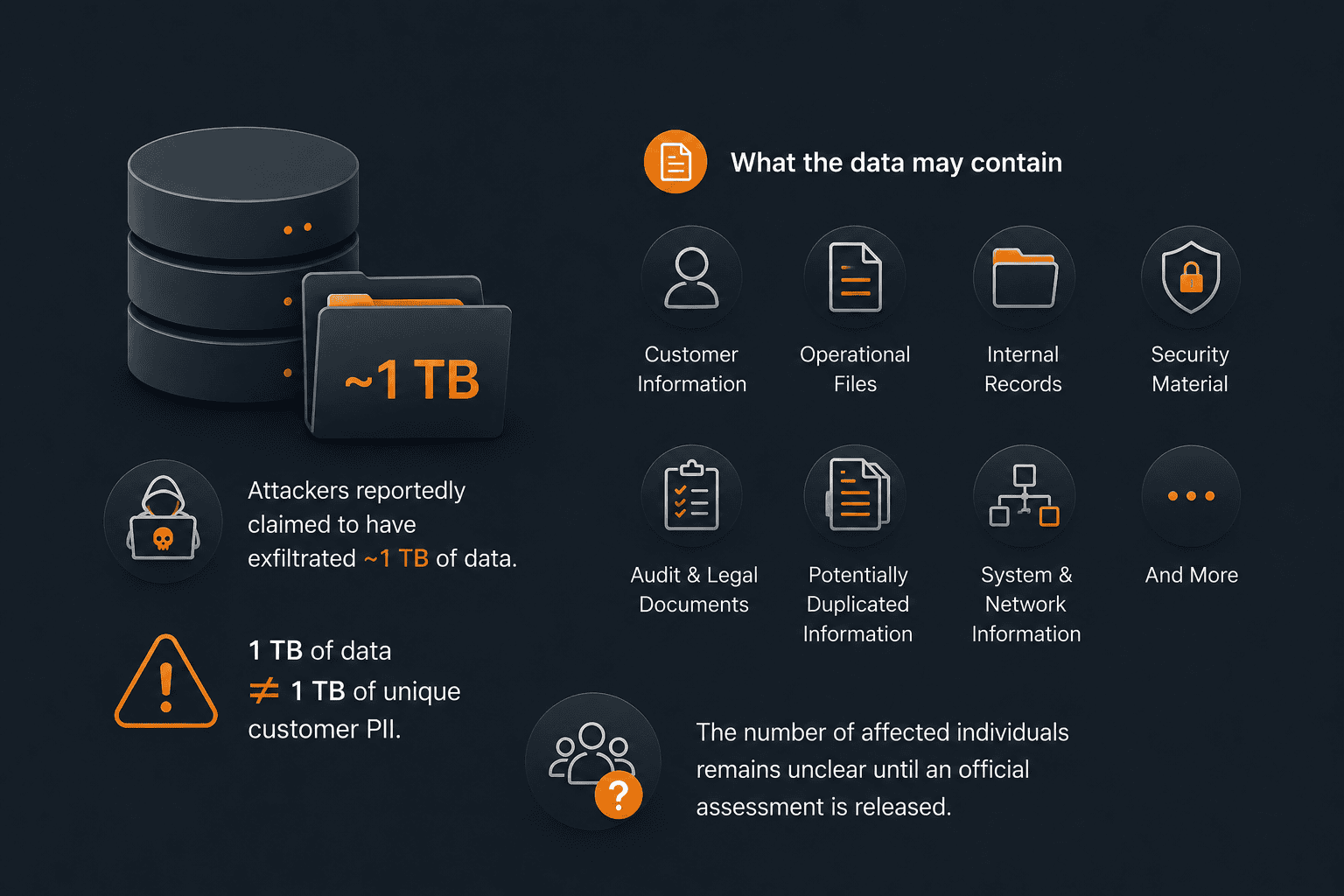
The attackers reportedly claimed to have exfiltrated approximately 1 TB of data, but that does not mean 1 TB of unique customer PII was compromised.
The dataset reportedly contains a combination of customer documents, operational files, internal records, audit information, security material and potentially duplicated information.
Similarly, the volume of files cannot be used to determine the number of affected customers.
Until the dataset has been fully assessed or Bank of Baroda provides an authoritative disclosure, the number of unique individuals whose personal information was compromised remains unclear.
What Is the PII Impact of the Bank of Baroda Data Breach?
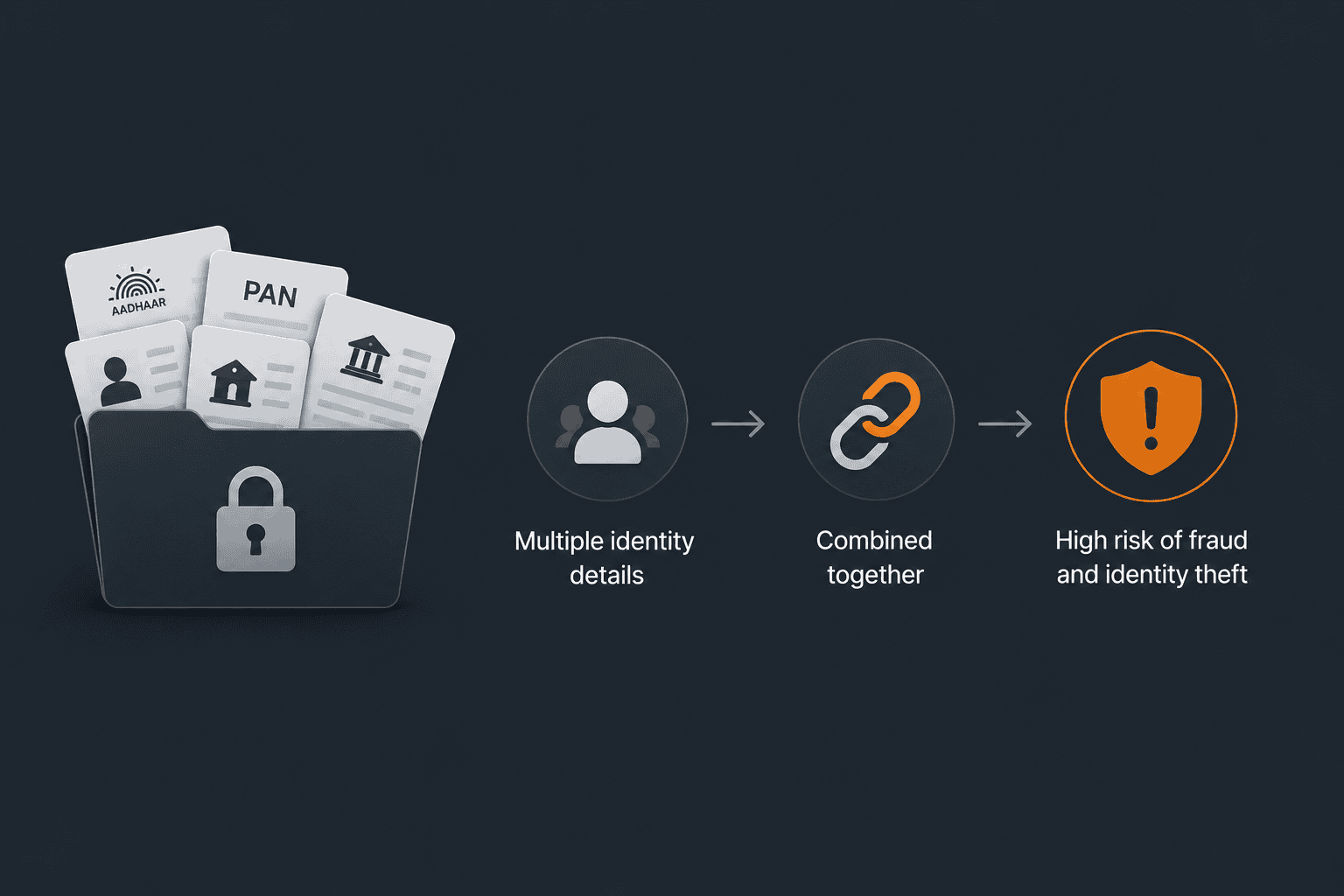
If the reported contents are validated, the potential PII impact is significant because the leaked information may combine multiple identity attributes belonging to the same individuals.
Aadhaar or PAN information alone is sensitive. When combined with names, photographs, addresses, account information, KYC documents or loan records, the resulting dataset can potentially enable much more convincing fraud and impersonation.
Affected individuals could consequently face risks including identity theft, targeted phishing, social engineering, impersonation attempts and financial fraud.
The cybersecurity impact therefore cannot be measured only by the size of the leak.
The sensitivity, context and ability to correlate the exposed information matter more than the raw number of gigabytes.
Did Bank of Baroda Lose Money in the Cyberattack?
As of the information currently available, there is no verified public figure establishing a direct monetary loss caused by the cyber incident.
There is currently no confirmed amount showing that attackers stole money directly from Bank of Baroda or customer accounts as part of this incident.
There is also no verified public figure for a ransom payment.
That does not mean the breach has no financial consequences.
Cyber incidents of this nature can create costs across forensic investigation, containment, infrastructure remediation, customer protection, legal response, regulatory compliance, communications, fraud monitoring and long-term security improvements.
The ultimate business impact may therefore take months or longer to quantify.
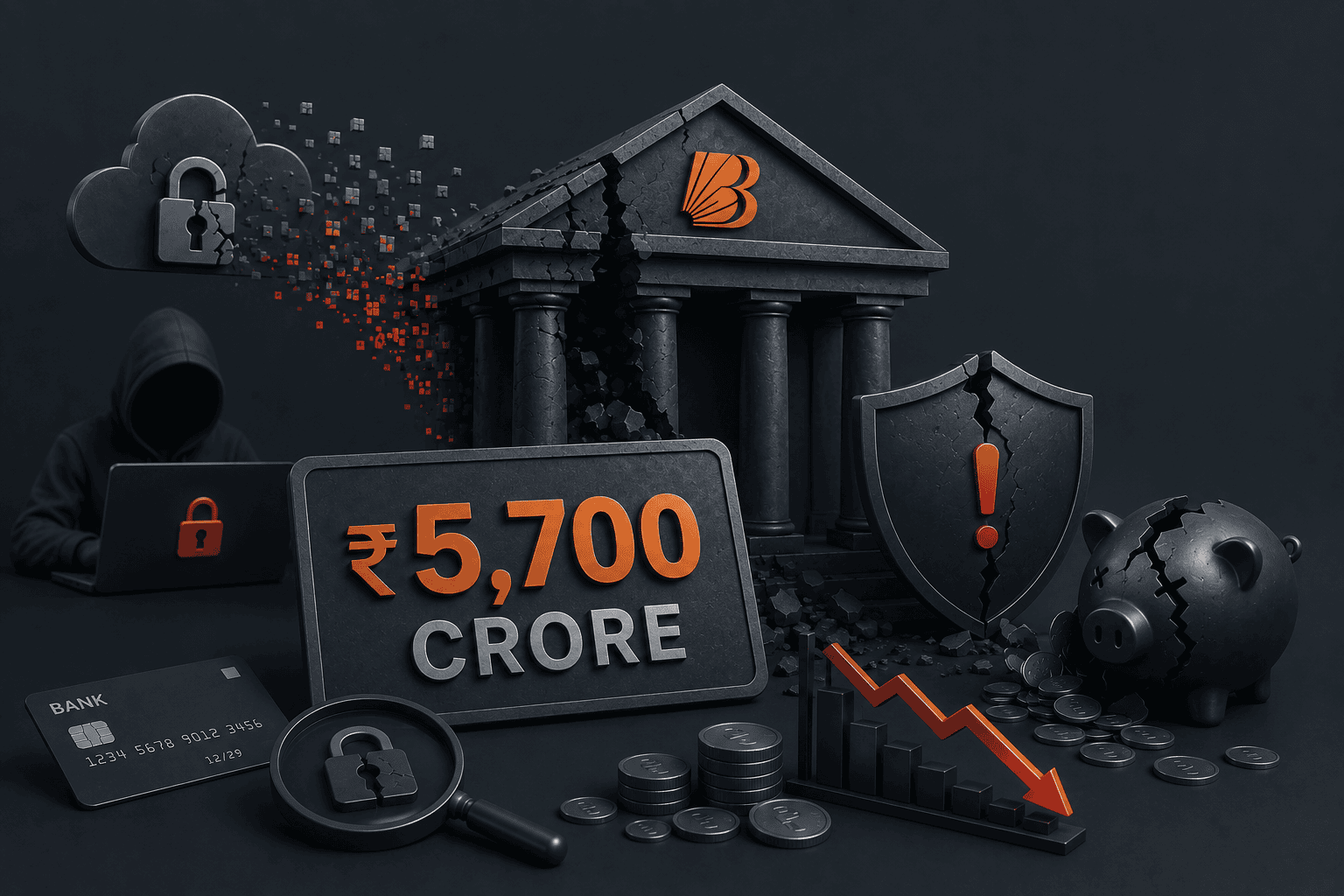
What About the ₹5,700 Crore Bank of Baroda Loss?
A ₹5,700 crore figure appearing in reporting around Bank of Baroda should not be confused with the cybersecurity incident.
The amount relates to a one-time exceptional charge associated with the NMC Health litigation settlement, according to financial reporting surrounding the bank’s Q1 FY27 results.
It is separate from the alleged data breach.
Attributing the ₹5,700 crore charge to the cyberattack would therefore be incorrect based on currently available information.
What Is the Potential Business Impact on Bank of Baroda?
The true cost of a major data breach extends beyond money stolen during the intrusion.
For a financial institution, trust itself is an important business asset.
Potential consequences can include incident response and forensic costs, customer protection expenses, increased fraud attempts, regulatory scrutiny, legal exposure, remediation of compromised infrastructure and additional investment in cybersecurity.
There is also the reputational dimension.
Customers trust banks not only to safeguard money, but also to protect the identity and financial information surrounding that money.
If internal security documents were also exposed, the bank may need to assess whether that information could provide adversaries with intelligence useful for future attacks.
That creates a second challenge: the breach itself may end, while the risk created by the stolen information persists.
Was Bank of Baroda’s Core Banking System Hacked?
There is currently no publicly established evidence that Bank of Baroda’s core banking system was compromised as part of the reported breach.
Independent analysis has suggested that at least some of the leaked material appears to have originated from internal document repositories or file-sharing infrastructure.
That distinction matters.
A breach involving internal documents and customer records can be extremely serious without requiring an attacker to compromise the bank’s core banking platform.
Claims that the attackers “hacked Bank of Baroda’s core banking system” should therefore not be made without additional evidence.
What Can Banks Learn From the Bank of Baroda Data Breach?
Whether every attacker claim is ultimately validated or not, the incident highlights a broader cybersecurity challenge facing banks and other large enterprises.
Credentials are no longer just a login mechanism. They are part of the attack surface.
Organizations should assume that credentials can eventually be stolen, phished, reused or otherwise compromised. Security architecture therefore needs to prevent one compromised identity from becoming unrestricted access across the enterprise.
That means strengthening multi-factor authentication, privileged access management, identity monitoring, network segmentation, least-privilege access and detection of abnormal authentication patterns.
Organizations also need controls capable of identifying unusual lateral movement and large-scale data transfers before sensitive information leaves the environment.
The objective is not merely to prevent initial access.
It is to ensure that one compromised account cannot become an enterprise-wide breach.
Why the Bank of Baroda Data Breach Matters for Indian BFSI
Banks hold a concentration of information that few other organizations possess.
They can hold identity information, financial records, contact information, transaction relationships, KYC documentation, employment or business information and lending records associated with millions of individuals and organizations.
That makes banking data exceptionally valuable to cybercriminals.
The Bank of Baroda data breach should therefore be viewed within a larger question facing India’s BFSI sector:
How resilient is an organization after an attacker obtains the first credential?
Preventing every credential compromise may be unrealistic.
Preventing that credential from becoming lateral movement, privilege escalation and mass data exfiltration is where cyber resilience becomes critical.
The Bigger Cybersecurity Lesson
The Bank of Baroda incident demonstrates why measuring cybersecurity only by whether attackers can enter an environment is no longer enough.
The more important question is:
What can an attacker do after getting in?
If compromised credentials can lead to privilege expansion, lateral movement, access to sensitive repositories and mass data exfiltration, the problem extends across identity, access control, detection, segmentation and data protection.
For banks and enterprises managing large volumes of sensitive information, cybersecurity must therefore move from perimeter protection toward continuous visibility into identity risk, exposure, access, behaviour and business impact.
The Bank of Baroda incident is still developing. The confirmed scale, number of affected individuals, attack path and ultimate financial impact may change as authoritative information becomes available.
Frequently Asked Questions About the Bank of Baroda Data Breach
What happened to Bank of Baroda?
A cyber-extortion group known as Triple X claimed to have compromised Bank of Baroda and stolen approximately 1 TB of data. Independent researchers and media reports have examined allegedly leaked material containing customer PII and internal bank documents. Several aspects of the incident remain under investigation.
Was Bank of Baroda hacked?
A threat actor has claimed to have breached Bank of Baroda and leaked data allegedly taken from the bank’s environment. The precise scope and technical intrusion path have not yet been fully established publicly.
Who hacked Bank of Baroda?
Triple X has claimed responsibility for the Bank of Baroda data breach. The attribution should currently be treated as a threat-actor claim unless confirmed through an authoritative investigation.
How much data was stolen from Bank of Baroda?
The threat actor has reportedly claimed approximately 1 TB of data. That figure represents the claimed overall dataset and should not be interpreted as 1 TB of unique customer PII.
What customer information was leaked?
The exposed material reportedly includes Aadhaar and PAN-related information, KYC documents, photographs, identity and address documents, account-related information and loan documents, among other records.
How many Bank of Baroda customers were affected?
A reliable number of unique affected customers has not yet been publicly established. File counts and the approximately 1 TB volume cannot be used as substitutes for an affected-customer count.
Did Bank of Baroda customers lose money?
There is currently no verified public figure establishing customer funds stolen as a result of the reported breach. Customers should nevertheless remain alert to phishing, impersonation and fraud attempts that could exploit exposed personal information.
How did the Bank of Baroda breach happen?
The threat actor reportedly claimed weak credentials were involved in obtaining initial access. Analysis has suggested that compromised credentials and subsequent lateral movement may have played a role, but the complete attack chain has not yet been officially established.
Was Bank of Baroda’s core banking system compromised?
There is currently no publicly established evidence that the bank’s core banking system was compromised. Reported analysis indicates that significant portions of the leaked material may have originated from internal file or document-sharing infrastructure.
What was Bank of Baroda’s financial loss from the breach?
No verified total financial loss attributable to the cyber incident has been publicly established. The ₹5,700 crore exceptional charge reported around the same period relates to the NMC Health litigation settlement and should not be attributed to the cyberattack.