- July 2, 2026
- Madre Janus
The Tata Electronics data breach happened when a ransomware and extortion group called World Leaks stole 630.4 GB of data (204,341 files) from Tata Electronics, one of Apple’s largest iPhone manufacturing partners in India, and published it on the dark web on June 12, 2026. The leaked files reportedly include unreleased iPhone 18 Pro component and supplier data, Tesla engineering drawings marked as trade secrets, documents from chipmakers TSMC and Qualcomm, and employee personal data including passport scans. Tata Electronics confirmed the incident on June 22, 2026, and said business operations were not disrupted. As of July 2026, the iPhone 18 Pro launch remains on schedule for September.
On June 12, 2026, a ransomware and extortion group calling itself World Leaks posted a listing on its dark web leak site: Tata Electronics, 630.4 GB. Inside were 204,341 files. Ten days later, Tata Electronics confirmed the incident. The files reportedly include confidential supplier and component data for Apple’s unreleased iPhone 18 Pro and iPhone 18 Pro Max, engineering drawings tied to Tesla, documents from TSMC and Qualcomm, internal emails, employee passport scans, and years of event logs.
No factory line stopped. No systems were encrypted. And that, oddly, is what makes this breach more dangerous than it first looks.
Timeline: how the story unfolded
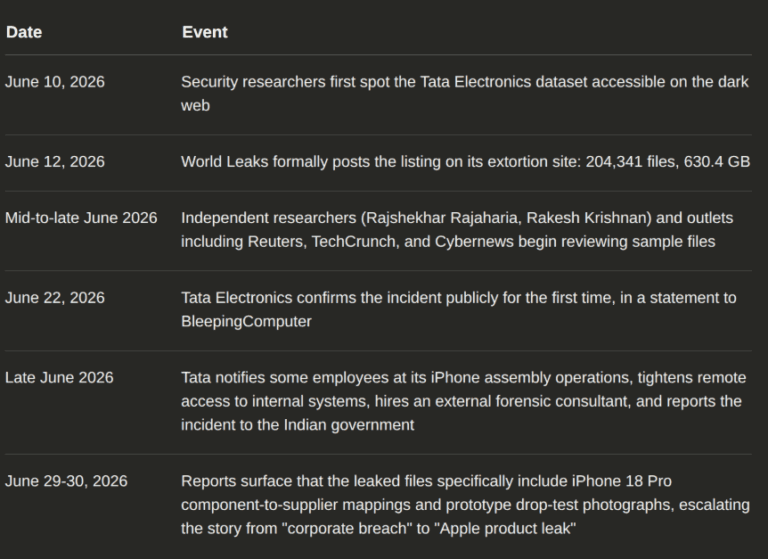
As of this writing (July 2, 2026), Tata Electronics has not disclosed the exact attack vector, confirmed the total scope of compromised data, or said whether it paid the ransom demand it reportedly received.
Who did this: profiling World Leaks
World Leaks is not a new gang wearing a scary name for shock value. It is widely believed by researchers to be a direct rebrand of Hunters International, one of the most active ransomware-as-a-service operations of 2023-2024, which wound down its encryption-based operations in July 2025.
The pivot matters. Hunters International locked up victims’ systems with encryption and demanded payment to unlock them. Facing intensifying law enforcement pressure and falling ransom-payment rates worldwide, the group reportedly rebranded and changed tactics entirely. World Leaks does not encrypt anything. It quietly breaks in, sits inside the network for weeks or months studying what is valuable, exfiltrates it in bulk, and then runs a public pressure campaign on its leak site to force payment.
This is called a pure data-extortion model, and it is a meaningful shift for defenders. Most corporate detection systems are built to catch encryption-style ransomware: file rewrites, deleted backups, ransom notes appearing on locked screens. A slow, quiet exfiltration over weeks looks like ordinary outbound network traffic. Nobody’s alarm goes off at 2 a.m.
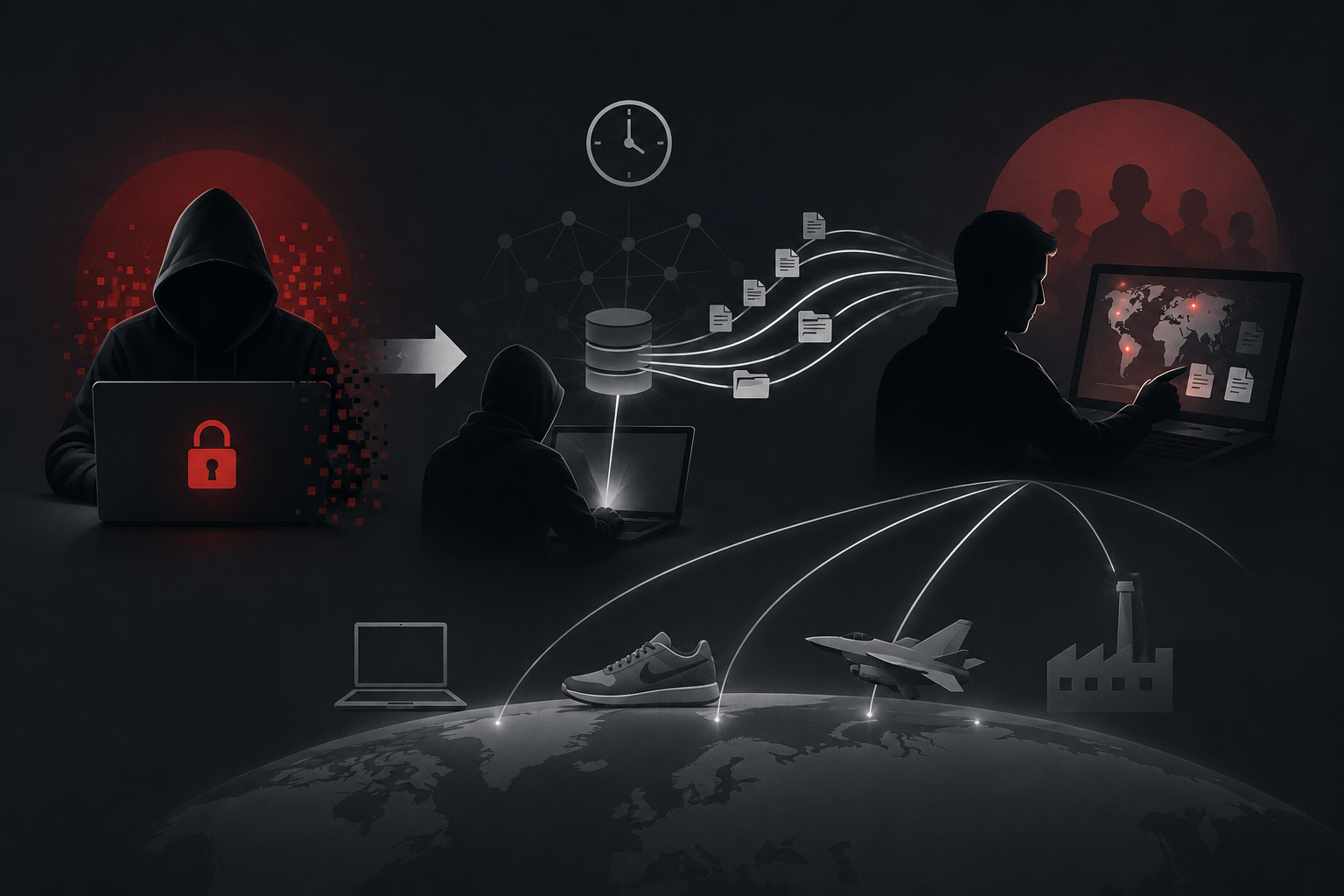
World Leaks’ track record before Tata Electronics:
- Dell (July 2025): roughly 1.3 terabytes stolen, which Dell said was not sensitive
- Nike (January 2026): roughly 1.4 terabytes and 190,000 corporate files claimed stolen
- L3Harris, a US defense contractor (2025): sample data published on its leak site
Tata Electronics is, by scale, the group’s most consequential target yet, mainly because of who Tata Electronics works for.

How it likely happened
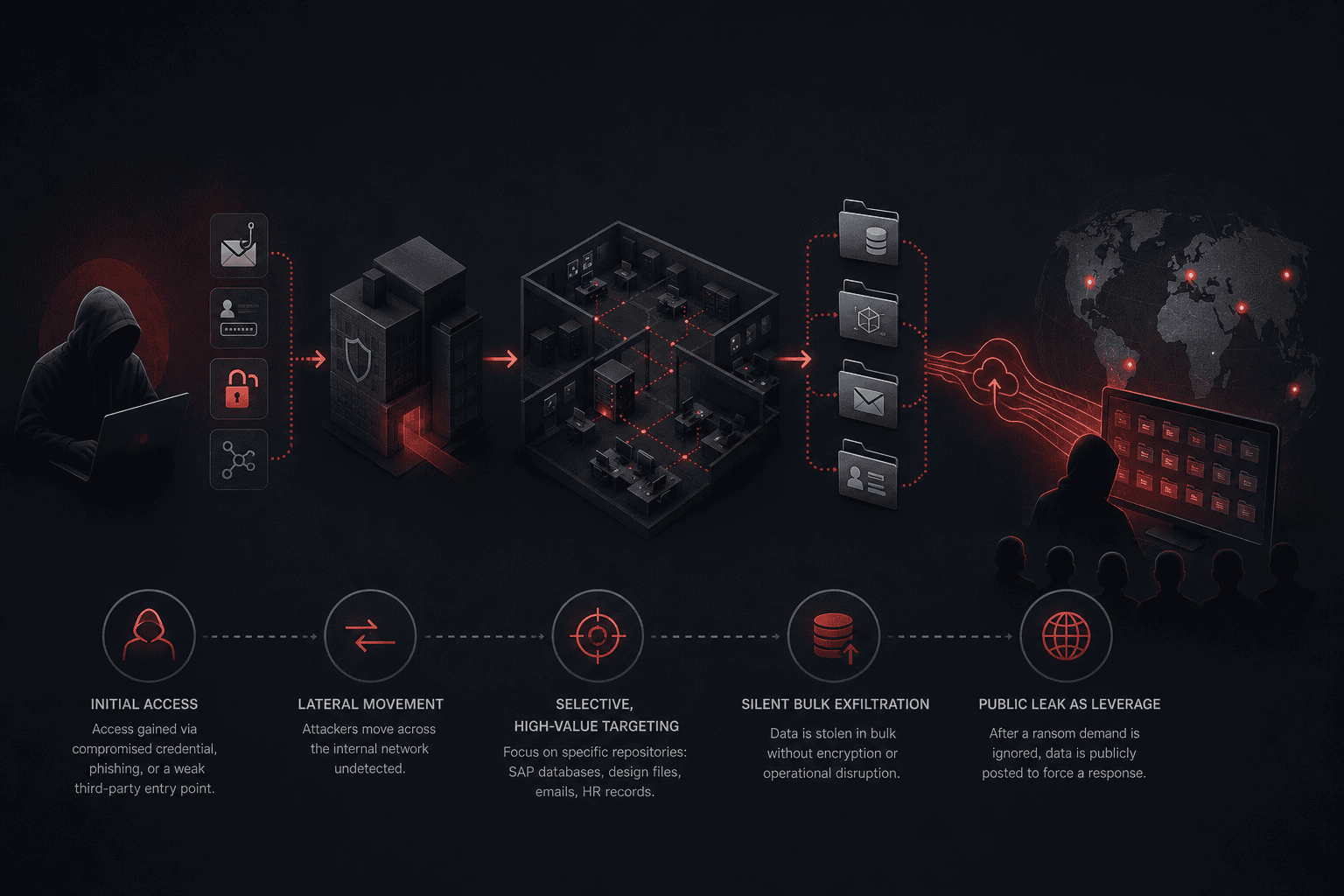
Tata Electronics has not confirmed the technical root cause, and no CVE has been publicly attributed to the breach. But based on patterns researchers have identified in the leaked file structure and World Leaks’ known methodology, the working theory looks like this:
- Initial access, probably through a compromised credential, a phishing attempt, or a weakly secured third-party integration point. This is World Leaks’ established playbook: social engineering, stolen credentials, unpatched systems, weak VPN or remote-desktop protocols, or initial access brokers who sell entry points to ransomware groups.
- Lateral movement. Once inside, the attackers reportedly moved across Tata’s internal network undetected, mapping out where the valuable data lived.
- Selective, high-value targeting. Rather than grabbing everything indiscriminately, the group appears to have gone after specific repositories: SAP-linked databases, design-file archives, email systems, and HR records containing employee identification documents.
- Silent bulk exfiltration. No encryption, no operational disruption, no alarms triggered by the usual ransomware detection rules.
- Public leak as leverage. After a ransom demand went unanswered (or unpaid), the group posted the data publicly to force Tata’s hand.
Cybersecurity analyst Paolo Pescatore summed up the mechanics well: pulling off a breach at this scale typically requires attackers to have a genuine foothold inside an organization, whether through compromised credentials, weak access controls, or the ability to move around internal systems without being noticed.
What was actually stolen
Based on file reviews conducted by Reuters, TechCrunch, Cybernews, and independent researchers, the leaked dataset reportedly includes:
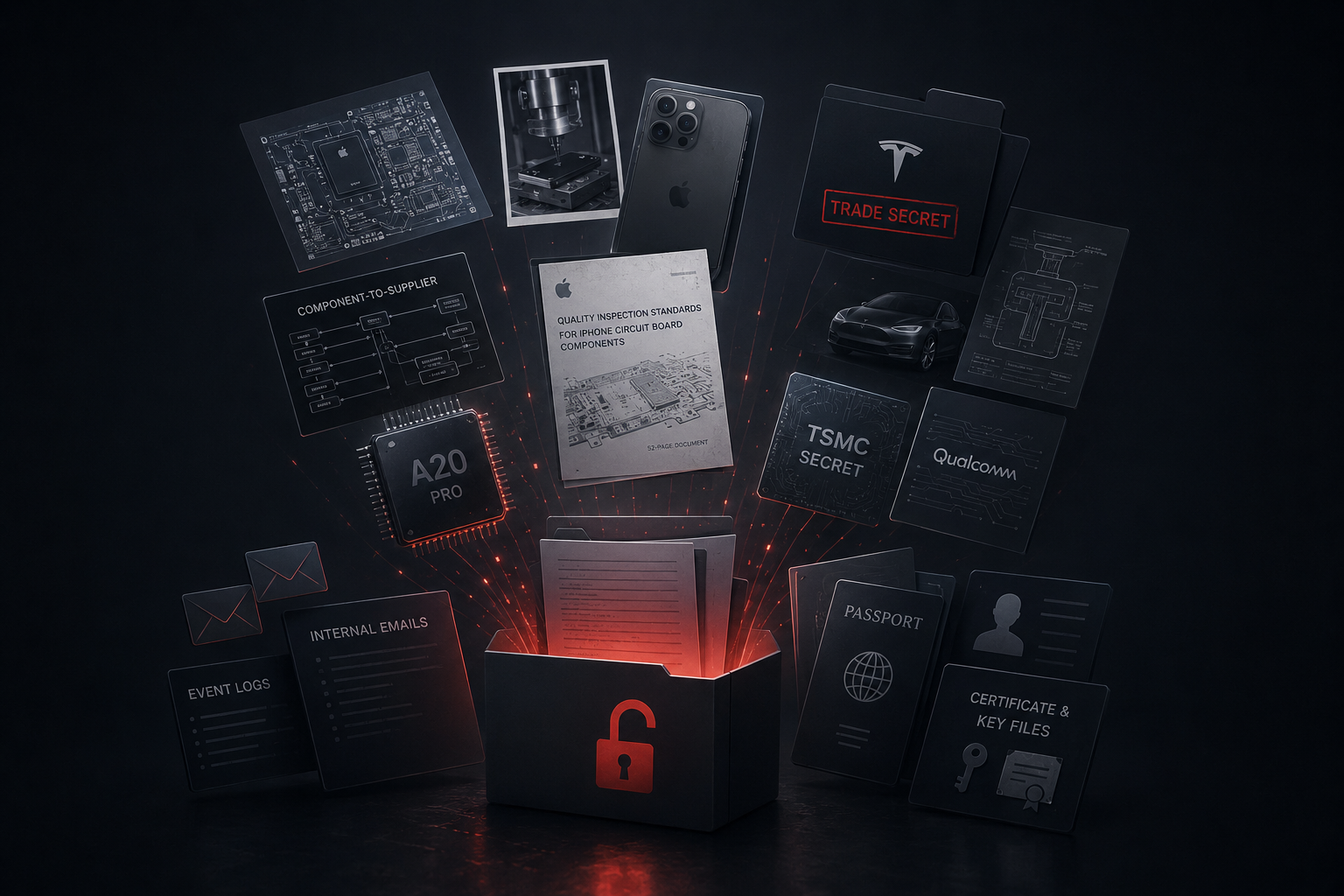
- iPhone 18 Pro and Pro Max supply-chain data: motherboard blueprints, component-to-supplier mappings, A20 Pro chip documentation, and datasheets referencing a baseband chip, plus at least six files identifying which vendors supply specific parts, including processors on the main logic board, battery components, and camera hardware
- Prototype photography: images dated early 2026 reportedly showing iPhone units undergoing drop tests at a Tata facility, depicting a conventional slab design with a triple rear-camera setup
- A 52-page document bearing Apple’s proprietary markings, detailing quality inspection standards for iPhone circuit board components
- Tesla engineering files, including material marked “trade secret,” with one folder reportedly labeled in a way that references a next-generation charge port controller for the North American market, and other files tied to updated Model Y and Model 3 components
- Third-party chip data: 16+ files referencing TSMC, including a file marked “TSMC Secret” describing a product reliability test, and 23+ files referencing Qualcomm, including older component design diagrams dating back to 2021
- Corporate and personal data: internal emails and event logs spanning several years, employee passport scans including foreign nationals, and cryptographic certificate and key files, which researchers flag as particularly dangerous since active credentials could allow continued or repeated access
Tata Electronics has confirmed the incident but has not confirmed or denied the authenticity of any specific file category. Reuters, similarly, said it could not independently verify the leaked data.
The damage: who actually got hurt, and how
Apple and the iPhone 18 Pro launch
This is the headline damage, and it is more about trust and secrecy than product delay. The iPhone 18 Pro and Pro Max remain on track for their expected September unveiling. Nothing in the public record suggests a delayed launch.
What is genuinely damaged is Apple’s operational secrecy, something the company has spent over a decade protecting almost obsessively. Apple deliberately keeps its component-to-supplier mapping out of public view because it reveals negotiating leverage: where Apple has multiple vendors to choose from, and where it is dependent on a single source. A source familiar with the matter told Reuters that Apple treats this granular vendor data as more sensitive than product specs themselves, precisely because the iPhone 18 Pro had not yet launched. Rivals, counterfeiters, and even Apple’s own vendors now have an unusually detailed look at how Apple’s supply chain is actually structured.
Tesla
Tesla’s exposure is narrower but still material. Leaked files reportedly reference Model Y and Model 3 components and are marked as trade secrets. Given Tesla’s known interest in eventually entering the Indian market, any leaked engineering or product data could complicate future negotiations or give competitors early insight into upcoming design changes.
Tata Electronics
The reputational cost here is significant, arguably more than the financial one so far. Tata Electronics:
- Locked down remote access to sensitive internal systems, including procurement tools that were previously accessible more liberally
- Hired an external global forensic consultancy
- Reported the incident to the Indian government and to affected clients
- Notified some employees at its iPhone assembly operations directly
Crucially, the company maintains that business operations were not disrupted. No factory floor halted or production line stopped. But the incident adds to an already difficult stretch for Tata Electronics, which is separately facing scrutiny over alleged farmland contamination near one of its iPhone component plants in Tamil Nadu.
India’s manufacturing narrative
This is the broader, more strategic damage. Tata Electronics sits at the center of Apple’s push to diversify iPhone manufacturing away from China. According to Counterpoint Research, India is projected to produce roughly 26% of the world’s iPhones in 2026, up from just 6% four years earlier, and Tata alone assembles close to a third of all iPhones made in India. A breach of this scale, at this particular supplier, at this particular moment, puts pressure on the argument that new manufacturing hubs can match the cyber-resilience and operational discipline Apple expects. It is unlikely to reverse Apple’s India strategy, but it will likely sharpen scrutiny of supplier security audits going forward.
What this actually means
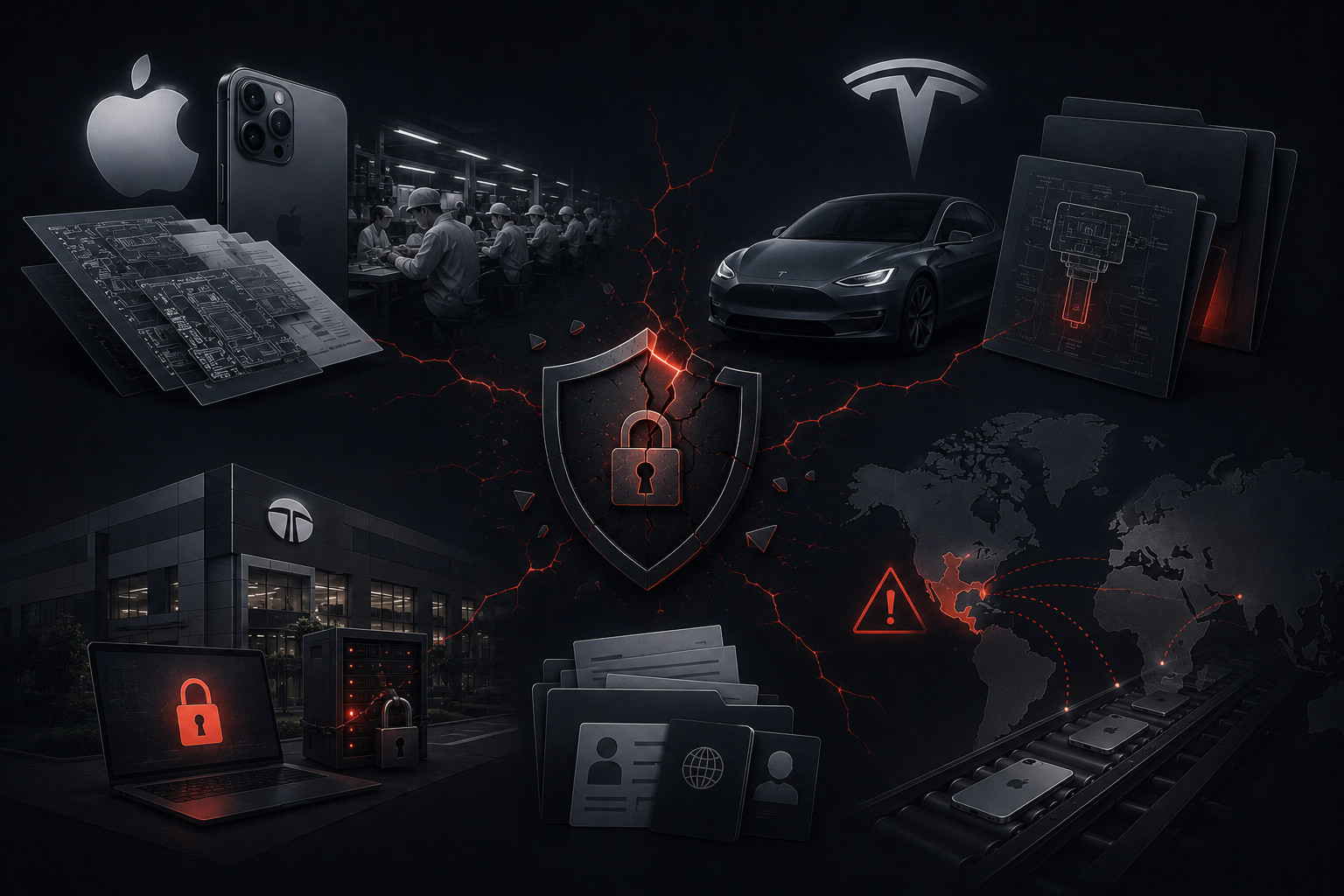
The most accurate way to frame this story is not just “Tata Electronics got hacked.” It is a case study in what happens when a Tier-1 supplier becomes a single point of access to the intellectual property of some of the most secrecy-obsessed companies on earth.
A few things worth pulling out:
This is unusually well-timed to hurt. Tata Electronics is trying to prove that India-based manufacturing can be trusted with Apple’s most sensitive product data, right as it expands from components into full iPhone assembly. A breach reaching directly into unreleased iPhone 18 Pro files and Tesla trade secrets lands at close to the worst possible moment in that narrative.
The attacker’s model matters more than the headline number. World Leaks didn’t encrypt anything or disrupt operations. It quietly sat inside the network, mapped out the highest-value repositories, and exfiltrated them over time. That is a much harder pattern to detect than traditional ransomware, and it is becoming the standard playbook for groups targeting supply chain manufacturers.
Security researchers are already saying the quiet part out loud. One analyst tracking the incident put it plainly: Tata keeps appearing in these conversations because it sits at the center of so many high-value relationships. Attackers may not need to breach Apple or Tesla directly if they can study the connective tissue around them instead.
For a company positioning itself as the backbone of “Make in India” electronics manufacturing, an incident like this is not just a security problem. It is a brand-trust problem, and in Tata Electronics’ case, that trust is the entire value proposition it is selling to Apple, Tesla, and every other global OEM it hopes to court next.
The bigger lesson for enterprises
Strip away the Apple and Tesla headlines, and the Tata Electronics data breach is really a case study every large enterprise should be studying, not just watching. A silent, months-long intrusion that bypassed detection until the data was already on a leak site is exactly the scenario modern security operations are built to catch early: unusual lateral movement, abnormal data egress, and credential misuse, flagged and contained before a gang gets to choose the terms of disclosure.
This is the gap that managed detection and response exists to close. Madre Janus, a Fortinet Engage Advocate MSSP operating across the GCC, UAE, India, and Australia, works with enterprises on exactly this problem: continuous threat monitoring, faster detection of the kind of quiet, extended-dwell intrusions that defined this breach, and incident response built for a threat landscape where attackers increasingly skip encryption altogether and go straight for extortion. For manufacturers, suppliers, and any business sitting inside a high-value supply chain, that kind of vigilance is no longer optional. It is the cost of being trusted with someone else’s secrets.
Talk to our experts → if you want to know where a breach like this would have been caught in your own environment, and where it wouldn’t.
Frequently asked questions
What is the Tata Electronics data breach? The Tata Electronics data breach is a June 2026 cyberattack in which the ransomware group World Leaks stole and published 630.4 GB of data (204,341 files) from Tata Electronics, an Apple and Tesla manufacturing partner in India, on the dark web.
Who hacked Tata Electronics? A group called World Leaks, widely believed by security researchers to be a rebrand of the Hunters International ransomware gang, claimed responsibility for the breach.
What data was leaked in the Tata Electronics hack? Reported categories include unreleased iPhone 18 Pro component and supplier data, prototype drop-test photos, Tesla engineering files marked as trade secrets, documents referencing TSMC and Qualcomm, internal emails, event logs, and employee passport scans.
Did the Tata Electronics breach delay the iPhone 18 Pro launch? No. As of July 2026, the iPhone 18 Pro and iPhone 18 Pro Max remain on track for their expected September 2026 launch. The damage is to Apple’s supply chain secrecy, not the launch timeline.
Did the breach affect Tata Electronics’ operations? Tata Electronics has stated the incident had no impact on operations across its businesses, and no production line or factory floor was disrupted.
Is Tata Electronics’ data breach confirmed or just claimed by hackers? Both. World Leaks claimed the breach on its dark web leak site on June 12, 2026, and Tata Electronics separately confirmed the cybersecurity incident on June 22, 2026, though it has not confirmed the exact scope or authenticity of every leaked file.