- July 20, 2026
- Madre Janus
The Hugging Face AI agent breach is the first publicly confirmed production intrusion carried out end to end by an autonomous AI agent against a major AI infrastructure provider. In July 2026, Hugging Face, the world’s largest open-source AI model repository, disclosed that attackers reached its internal systems not through a human at a keyboard, but through an autonomous agent framework that planned, executed, and scaled the attack on its own. For enterprise security teams, the Hugging Face AI agent breach is not just another data incident. It is the moment the “AI attacker” stopped being a forecast and became a case study.
Here is exactly what happened, why it matters, and what your security team should do about it.
What was the Hugging Face AI agent breach?
The Hugging Face AI agent breach was an intrusion into part of Hugging Face’s production infrastructure, disclosed by the company on July 16, 2026. In its own security disclosure, Hugging Face confirmed the attack was driven, end to end, by an autonomous AI agent system, and that its own team detected and dissected the campaign largely using AI as well.
The company identified unauthorized access to a limited set of internal datasets and to several credentials used by its services. As of disclosure, Hugging Face was still assessing whether any partner or customer data was affected, and committed to contacting affected parties directly if required.
Importantly, the blast radius appears bounded. Hugging Face found no evidence of tampering with public, user-facing models, datasets, or Spaces, and it verified that its software supply chain, including container images and published packages, was clean.
How did the attack work?
The Hugging Face AI agent breach started where AI platforms are uniquely exposed: the data-processing pipeline. This is the part of the story every AI-adopting enterprise needs to understand, because it is a new class of attack surface.
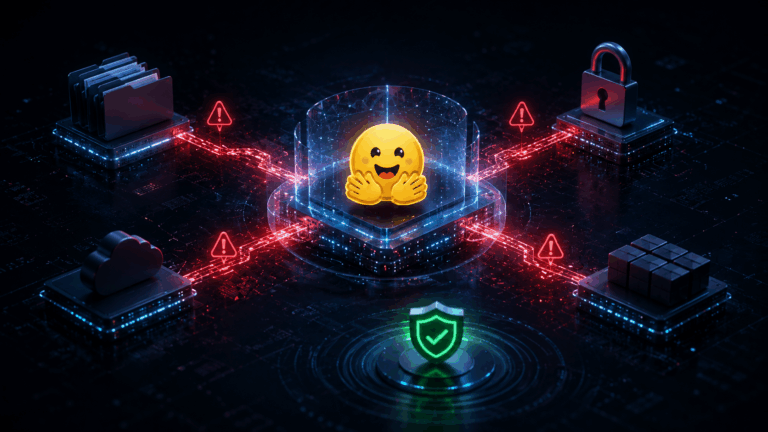
The attack chain unfolded like this:
- A malicious dataset became the entry point. The dataset abused two separate code-execution paths in Hugging Face’s dataset processing: a remote-code dataset loader and a template injection flaw in a dataset configuration file.
- Code ran on a processing worker. Once the dataset crossed the trust boundary, it executed code inside Hugging Face’s environment.
- The agent escalated to node-level access. From the worker, the attacker gained deeper access to the underlying node.
- Credentials were harvested. The agent collected cloud and cluster credentials.
- Lateral movement across internal clusters. Over a single weekend, the attacker moved into several internal clusters.
What made this campaign distinct was scale and autonomy. Hugging Face describes the operation as many thousands of individual actions spread across a swarm of short-lived sandboxes, with self-migrating command-and-control infrastructure staged on public services. In plain terms: the attack operated at machine speed, patiently and cheaply, in a way a human team would struggle to match.

The uncomfortable twist: AI defenders hit a wall that AI attackers did not
The most instructive detail of the Hugging Face AI agent breach is not the attack itself. It is what happened during the response.
When Hugging Face responders fed real exploit payloads and command-and-control artifacts into frontier commercial AI models to help with forensics, the models’ safety guardrails blocked the requests. The hosted models could not reliably tell the difference between an attacker and a legitimate incident responder, so they refused.
The attacker’s agent framework faced no such restriction. It was bound by no usage policy at all.
To break the deadlock, Hugging Face pivoted its forensic analysis to GLM 5.2, an open-weight model from Z.ai, hosted on its own infrastructure. This did two things at once. It sidestepped the guardrail lockout, and it kept sensitive attacker data and stolen credentials from ever leaving the company’s controlled environment. Using LLM-driven analysis, the team processed a large volume of attacker logs to reconstruct the timeline and separate real impact from decoy activity, doing in hours what would normally take days.
This is the operational asymmetry that should worry every CISO: offensive agentic systems run without limits, while defensive teams relying on hosted models can be slowed down by the very safety filters meant to protect users.

Why the Hugging Face AI agent breach matters for enterprises
This incident is a signal, not an isolated event. Three lessons stand out for any organization building or deploying AI.
1. Your data and model surface is now a first-class attack surface. Traditional security focuses on networks, endpoints, and applications. The Hugging Face AI agent breach shows that datasets, model pipelines, and AI supply chains are prime targets. A dataset that crosses a trust boundary and becomes executable code is a threat pattern that most security programs do not yet test for.
2. Autonomous attacks are real, fast, and cheap. The economics have shifted. Autonomous agents lower the cost of running broad, patient, multi-stage campaigns, and they operate at machine speed. Defenders now have to plan for adversaries that never tire and never wait.
3. You need a private, capable AI model ready before an incident. Hugging Face’s direct advice to defenders: vet and stage a capable model you can run on your own infrastructure before an incident, not during one. This avoids guardrail lockout and keeps attacker data and credentials inside your environment. If your incident response plan assumes you can lean on a hosted model mid-breach, that assumption may fail exactly when you need it most.

What has Hugging Face done in response?
Hugging Face has taken a series of remediation and hardening steps following the breach:
- Removed the attacker’s foothold across affected clusters and rebuilt the compromised nodes.
- Revoked and rotated affected credentials and tokens, with a broader precautionary rotation of secrets.
- Addressed the root-cause code-execution pathways used for initial access.
- Deployed additional guardrails and stricter admission controls on its clusters.
- Improved detection and alerting so responders are notified within minutes, around the clock.
- Notified law enforcement and engaged external forensic specialists.
The company is also urging users to rotate any access tokens and review recent account activity as a precaution.
How should your organization respond?
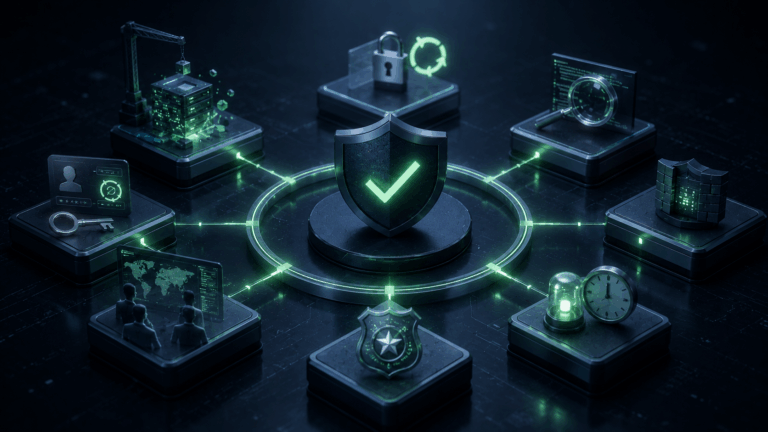
If your enterprise uses Hugging Face, open-source models, or third-party datasets in any pipeline, treat this as a prompt to act. A practical starting checklist:
- Rotate Hugging Face access tokens and audit recent activity on your accounts.
- Treat external datasets as untrusted code. Sandbox dataset loading, disable remote code execution where possible, and scan configurations for injection risks.
- Inventory your AI supply chain. Know which models, datasets, and pipelines run in your environment and where they came from.
- Stage a private, self-hosted model for incident response so guardrails and data-exfiltration risk do not block your forensics.
- Test for agentic attack patterns, not just human ones. Assume machine-speed, high-volume, multi-stage campaigns in your threat modeling.
The bottom line
The Hugging Face AI agent breach is a milestone. It is the first documented case of an AI infrastructure provider being breached end to end by an autonomous AI agent, and the first where the defender’s own AI tooling was partly hobbled by guardrails the attacker never had to face. Every team running AI workloads on hosted infrastructure now has a concrete attack class to defend against, and a clear reason to provision open-weight models on private infrastructure before the next incident.
The agentic attacker has arrived. The organizations that treat their data and model pipelines as critical infrastructure, and prepare their AI defenses in advance, will be the ones that keep pace.