- June 7, 2026
- Madre Janus
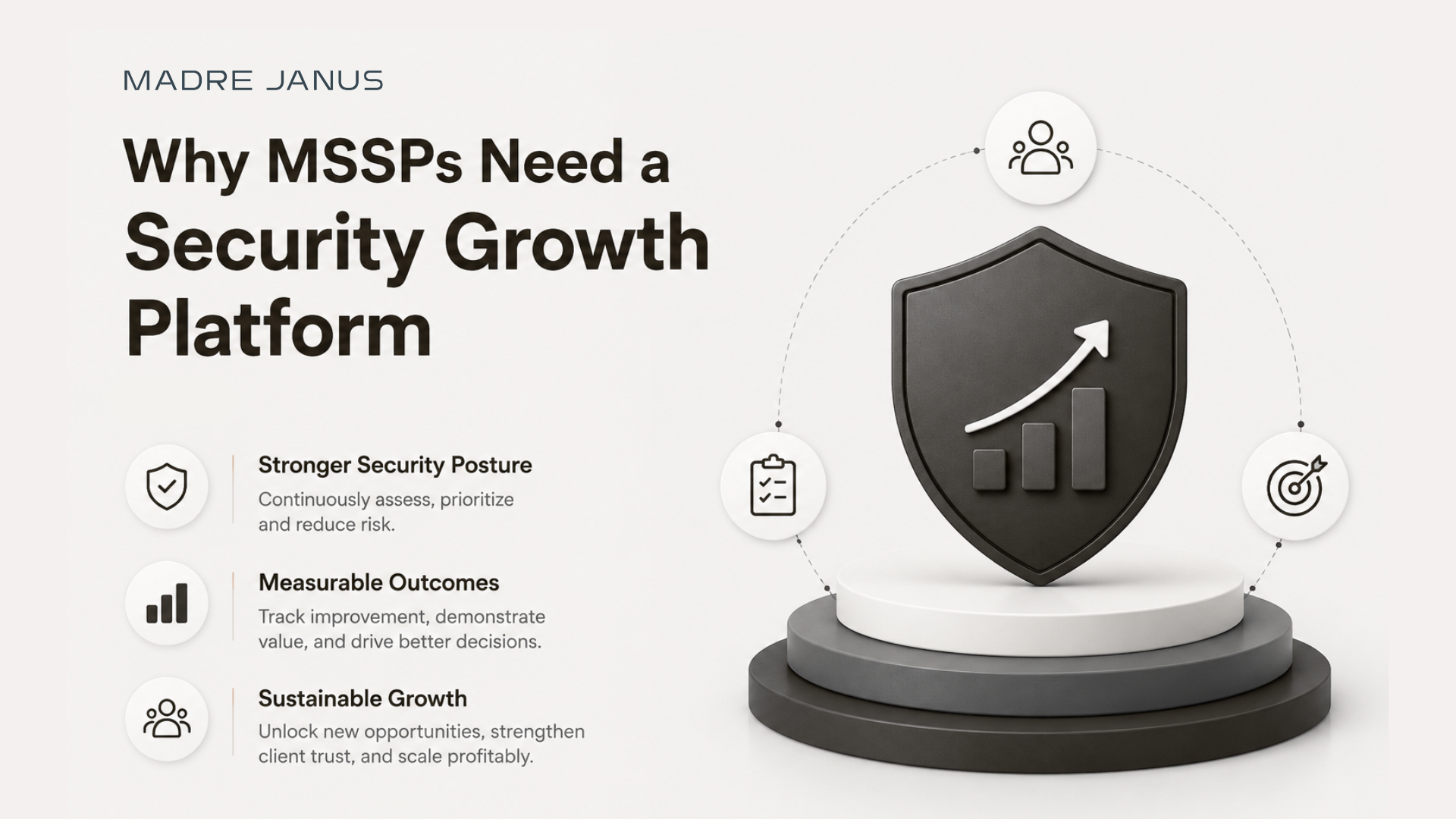
The Security Growth Platform is rapidly emerging as the next evolution of managed cybersecurity services. As organizations demand measurable security outcomes instead of simply purchasing more security tools, MSSPs are being challenged to move beyond traditional service delivery models. A Security Growth Platform enables providers to combine cybersecurity advisory, risk management, compliance oversight, and security posture improvement into a unified approach that delivers tangible business value and long-term cyber resilience.
For years, Managed Security Service Providers (MSSPs) have helped organizations defend against cyber threats through a combination of security technologies, monitoring services, incident response, and compliance support. While these capabilities remain essential, customer expectations have evolved significantly.
Today’s organizations are not asking how many security tools they own.
They are asking whether those investments are reducing risk, strengthening resilience, and improving their overall security posture.
This shift is creating a new reality for MSSPs.
Success is no longer determined by the number of products deployed or alerts processed. Instead, it is measured by an organization’s ability to demonstrate meaningful cybersecurity improvement over time.
This is where the concept of the Security Growth Platform becomes increasingly relevant.

What Is a Security Growth Platform?
A Security Growth Platform is a strategic framework that combines cybersecurity management, executive-level advisory services, risk intelligence, compliance oversight, and continuous security improvement into a single operational approach.
Unlike traditional security management solutions that focus primarily on technology administration, a Security Growth Platform focuses on outcomes.
Its objective is to help organizations understand:
- Their current cybersecurity maturity
- Their most critical business risks
- Their compliance obligations
- Their security improvement priorities
- Their long-term cyber resilience goals
A mature Security Growth Platform enables organizations to move from reactive cybersecurity management to proactive security leadership.
Rather than simply identifying problems, it provides a roadmap for continuous improvement.

Why Traditional Security Services are no longer enough
Cybersecurity has become increasingly complex.
Organizations now face:
- Sophisticated ransomware attacks
- AI-powered cyber threats
- Expanding cloud environments
- Hybrid workforces
- Regulatory pressure
- Supply chain vulnerabilities
- Third-party risk exposure
As a result, security leaders are under increasing pressure to justify cybersecurity investments and demonstrate measurable business value.
Historically, cybersecurity providers focused on delivering services such as:
- Firewall management
- Endpoint protection
- Security monitoring
- Vulnerability scanning
- SIEM management
- Incident response
While these services remain critical, they often answer operational questions rather than strategic business questions.
Business leaders increasingly want answers to questions such as:
- Are we becoming more secure?
- Which risks require immediate attention?
- How mature is our cybersecurity program?
- Where should we invest next?
- How do we compare with industry peers?
- What improvements have we achieved over the past year?
Traditional service models are not always designed to answer these questions effectively.
The Security Growth Platform fills that gap.

The Evolution of MSSPs
The role of the MSSP is changing.
Historically, MSSPs acted primarily as technology providers and security operators. Their primary responsibility was managing security tools and responding to threats.
Today, organizations expect something more.
They want cybersecurity partners that can provide strategic guidance and business-focused recommendations.
As cyber risk becomes a boardroom issue, MSSPs are increasingly being asked to support:
- Executive decision-making
- Cybersecurity strategy development
- Risk management initiatives
- Governance frameworks
- Compliance programs
- Security maturity assessments
- Long-term resilience planning
This transformation is redefining the value MSSPs deliver.
The most successful providers are evolving from security operators into trusted cybersecurity advisors.

Why Security Outcomes Matter More Than Security Products
For decades, the cybersecurity industry has focused on technology adoption.
Organizations continuously invested in:
- Antivirus solutions
- Firewalls
- Endpoint detection and response platforms
- Identity security tools
- Security monitoring systems
- Threat intelligence platforms
However, acquiring more technology does not automatically improve security.
In many cases, organizations already operate dozens of disconnected security solutions.
This creates new challenges:
- Alert fatigue
- Operational complexity
- Resource constraints
- Visibility gaps
- Increased management overhead
The result is often a larger security stack without a corresponding improvement in security outcomes.
This is why organizations are shifting their focus toward measurable results.
Examples of meaningful cybersecurity outcomes include:
- Reduced critical risk exposure
- Faster remediation timelines
- Improved compliance readiness
- Enhanced cyber resilience
- Lower attack surface exposure
- Better third-party risk management
- Increased security maturity
These outcomes provide a more accurate representation of cybersecurity effectiveness than the number of tools deployed.

Security Posture Improvement: The New Priority
Security posture management is becoming a central objective for modern cybersecurity programs.
Rather than focusing solely on threat detection, organizations are increasingly evaluating how their overall security posture improves over time.
A strong security posture reflects an organization’s ability to:
- Identify risks
- Prioritize remediation efforts
- Implement security controls
- Maintain compliance
- Respond to incidents
- Recover from disruptions
Security posture improvement allows leadership teams to understand whether cybersecurity investments are delivering meaningful value.
It transforms cybersecurity from a technical function into a measurable business initiative.
Organizations that continuously improve their security posture are better positioned to withstand evolving threats and maintain operational resilience.

The Growing Importance of Cybersecurity Advisory Services
The future of cybersecurity services extends beyond technology management.
Organizations increasingly require strategic guidance to navigate complex risk environments.
This has led to growing demand for:
Virtual CISO services
Cybersecurity consulting
Governance and compliance advisory
Risk management programs
Security strategy development
Executive reporting
Security maturity assessments
These services help organizations align cybersecurity initiatives with broader business objectives.
They also provide executive leadership with the visibility needed to make informed decisions regarding risk, investment, and resilience.
A Security Growth Platform supports this evolution by providing a structured framework for continuous advisory engagement.

CTO Perspective: Why Outcomes Will Define the Future of MSSPs
According to Mr. Shishir, CTO of Madre Janus:
“The future belongs to MSSPs that guide security outcomes, not those that merely sell security products.”
This statement reflects one of the most significant shifts occurring across the cybersecurity industry today.
Organizations are becoming increasingly focused on measurable security improvement rather than technology acquisition alone.
As Shishir further explains:
“Customers do not want more security tools; they want measurable improvement in their security posture. The MSSPs that can demonstrate and manage that improvement will grow faster than those that only resell technology.”
This perspective aligns with the growing demand for business-focused cybersecurity strategies that prioritize outcomes, resilience, and long-term risk reduction.
The cybersecurity providers that can effectively measure, communicate, and improve client security posture will be best positioned to lead the next phase of industry growth.
What Organizations Should Look for in an MSSP
The cybersecurity industry is entering an outcome-driven era.
Organizations are increasingly prioritizing:
- Risk reduction
- Security maturity
- Cyber resilience
- Compliance readiness
- Strategic guidance
- Executive visibility
This shift is changing how cybersecurity value is measured.
The future will belong to MSSPs that help organizations improve their security posture, strengthen resilience, and achieve measurable business outcomes.
The Security Growth Platform represents a significant step in that direction.
It moves cybersecurity beyond tools and technology toward a model centered on continuous improvement, strategic advisory, and demonstrable value.
For organizations seeking to navigate today’s increasingly complex threat landscape, that shift may prove to be one of the most important cybersecurity developments of the coming decade.
How Madre Janus Helps Organizations Build Security-Driven Growth
At Madre Janus, we believe cybersecurity should deliver measurable business outcomes, not just technical outputs.
Our approach combines cybersecurity advisory, risk management, governance, compliance support, security operations, and resilience-focused strategies to help organizations strengthen their security posture and reduce cyber risk.
Whether your organization is developing a cybersecurity roadmap, improving governance frameworks, enhancing resilience, or seeking executive-level cybersecurity guidance, our experts can help transform security into a strategic business enabler.
Learn More About Madre Janus
Website: https://www.madrejanus.com
Cybersecurity Services: https://www.madrejanus.com/services
Contact Us: https://www.madrejanus.com/contact-us
LinkedIn: https://www.linkedin.com/company/madrejanus
Ready to move beyond security tools and focus on measurable cybersecurity outcomes? Connect with Madre Janus to discover how a strategic, outcome-driven approach can strengthen resilience and support sustainable business growth.