- June 23, 2026
- Madre Janus
FIFA World Cup 2026 cyber threats are not contained to North America. If your enterprise has employees watching matches, vendors connected to the event ecosystem, or clients in any host country, you are inside the attack surface right now.
What makes FIFA 2026 different from every World Cup before it
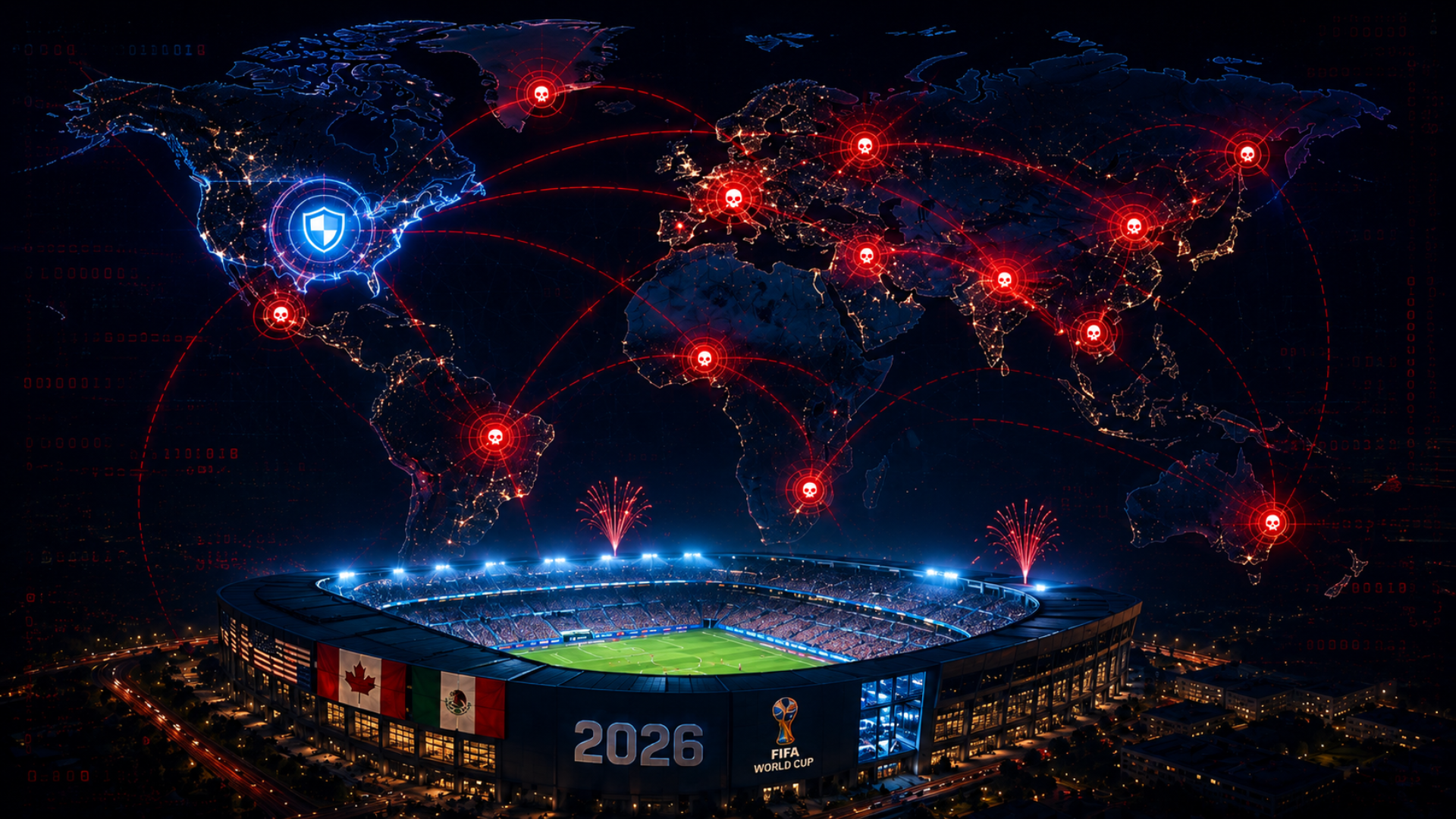
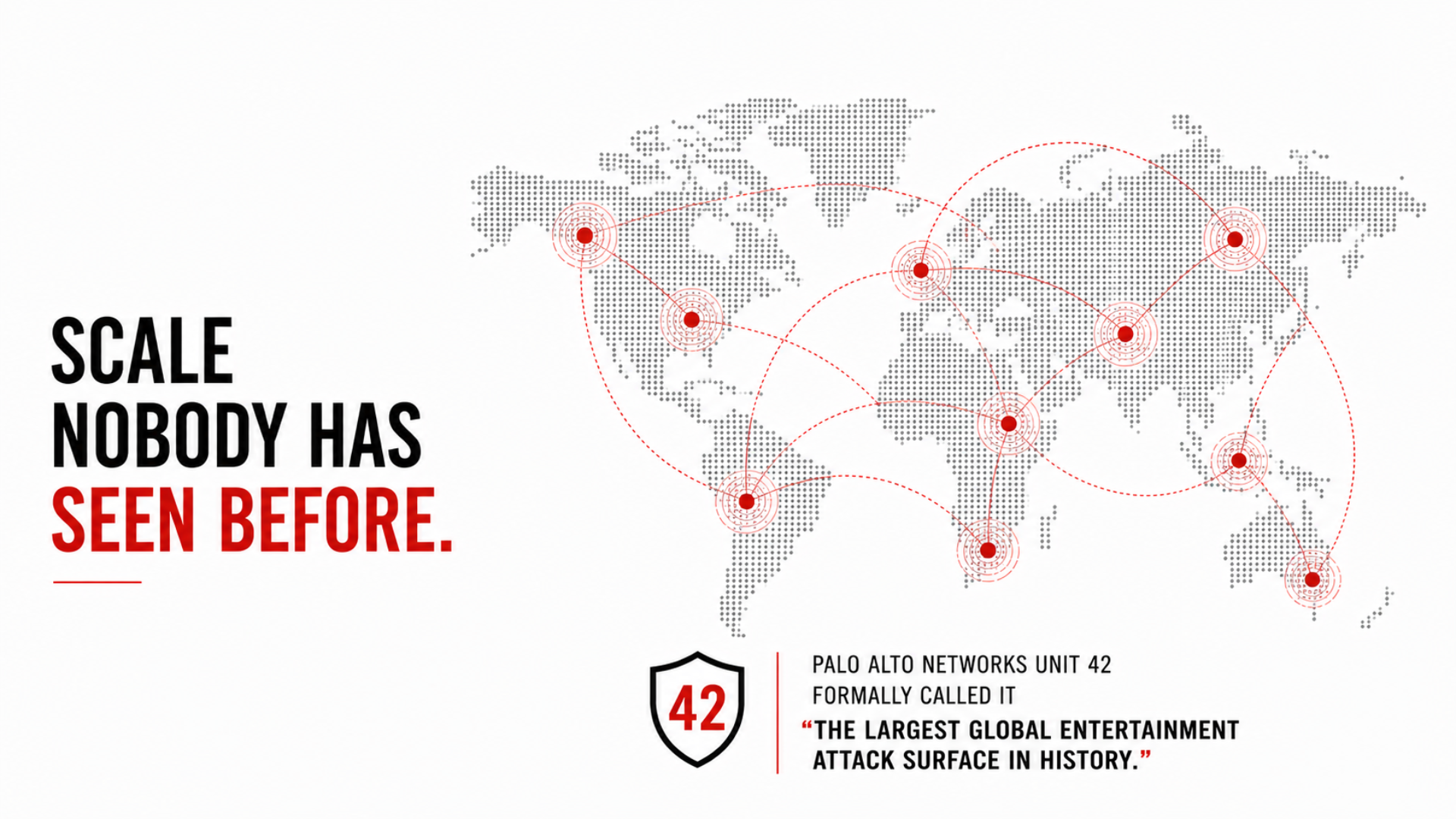
Scale nobody has seen before. Three host nations. Sixteen cities. 104 matches. An estimated 6.5 million in-venue spectators and a broadcast audience approaching half the planet. Palo Alto Networks Unit 42 formally called it the largest global entertainment attack surface in history.
(Source: Unit 42, June 2026)
Active geopolitical conflict running in parallel. The US-Israel-Iran conflict that began February 28, 2026, and the ongoing Russia-NATO confrontation have given hacktivist groups state-level motive and resources to target a US-hosted event. This is documented, not speculative.
(Source: CISA Advisory AA26-097A, April 7, 2026)
AI eliminated the tells. Darktrace’s June 2026 report on cybersecurity in global sport found that 83% of cybersecurity professionals in professional sports detected AI being used in attacks against them in the past 12 months. Phishing emails now contain novel social engineering features that pass DMARC authentication 84% of the time.
(Source: Darktrace, Cybersecurity in Global Sport, June 2026)
The numbers behind the threat
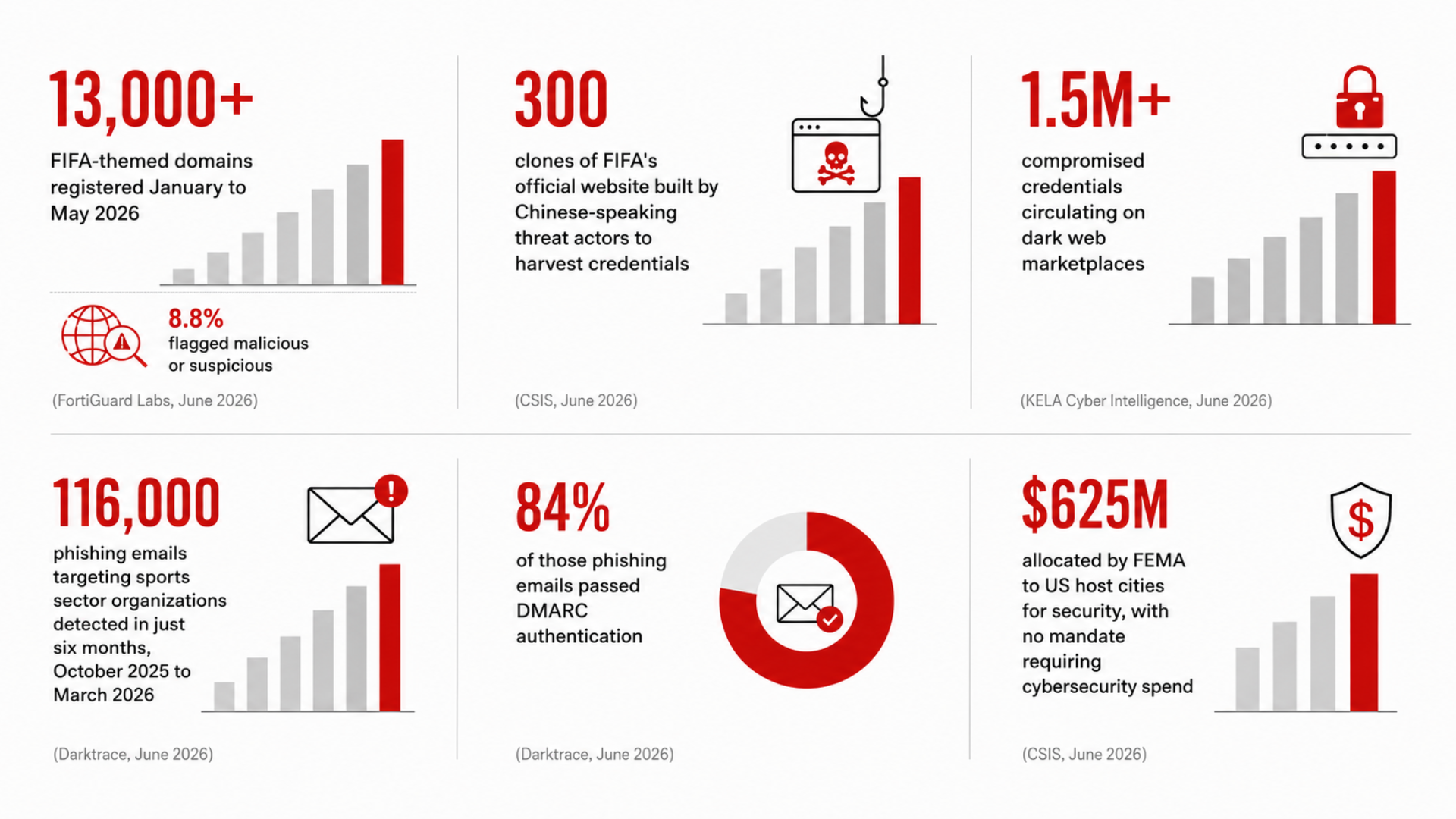
- 13,000+ FIFA-themed domains registered January to May 2026, 8.8% flagged malicious or suspicious (FortiGuard Labs, June 2026)
- 300 clones of FIFA’s official website built by Chinese-speaking threat actors to harvest credentials (CSIS, June 2026)
- 1.5 million+ compromised credentials circulating on dark web marketplaces (KELA Cyber Intelligence, June 2026)
- 116,000 phishing emails targeting sports sector organizations detected in just six months, October 2025 to March 2026 (Darktrace, June 2026)
- 84% of those phishing emails passed DMARC authentication (Darktrace, June 2026)
- $625 million allocated by FEMA to US host cities for security, with no mandate requiring cybersecurity spend (CSIS, June 2026)
The five attack types hitting enterprises right now
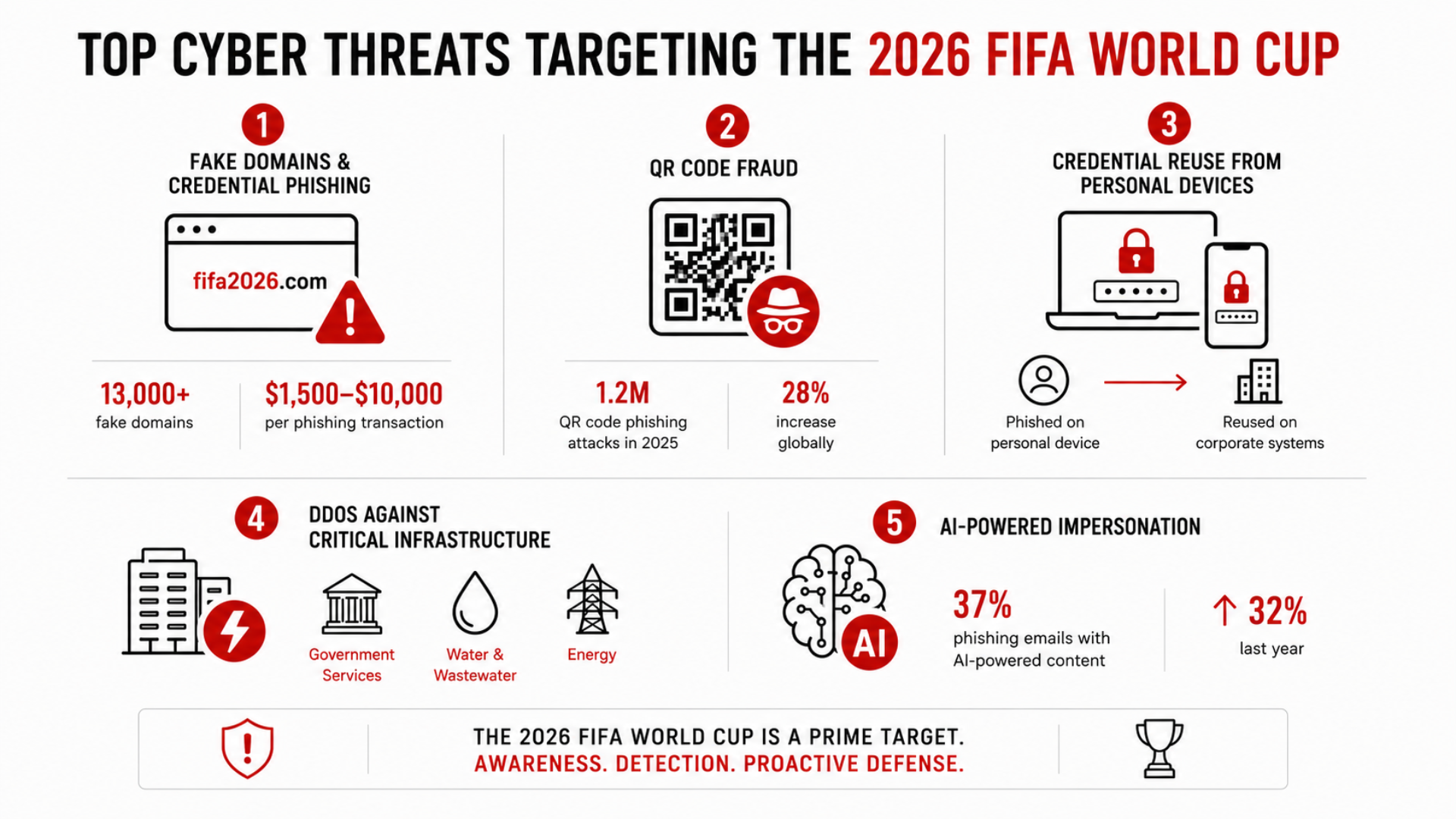
Fake domains and credential phishing. FortiGuard Labs confirmed 13,000+ FIFA-themed domains registered through May 2026. The FBI issued a formal IC3 Public Service Announcement in May 2026 warning of active FIFA website spoofing. Premium hospitality phishing transactions run $1,500 to $10,000 each.
QR code fraud. Darktrace recorded a 28% increase in QR code phishing globally in 2025, reaching 1.2 million attacks. The Canadian Centre for Cyber Security identified QR code fraud as the fastest-growing threat variant at the tournament. Fake codes for shuttle passes, parking, and match entry are already circulating at watch parties globally.
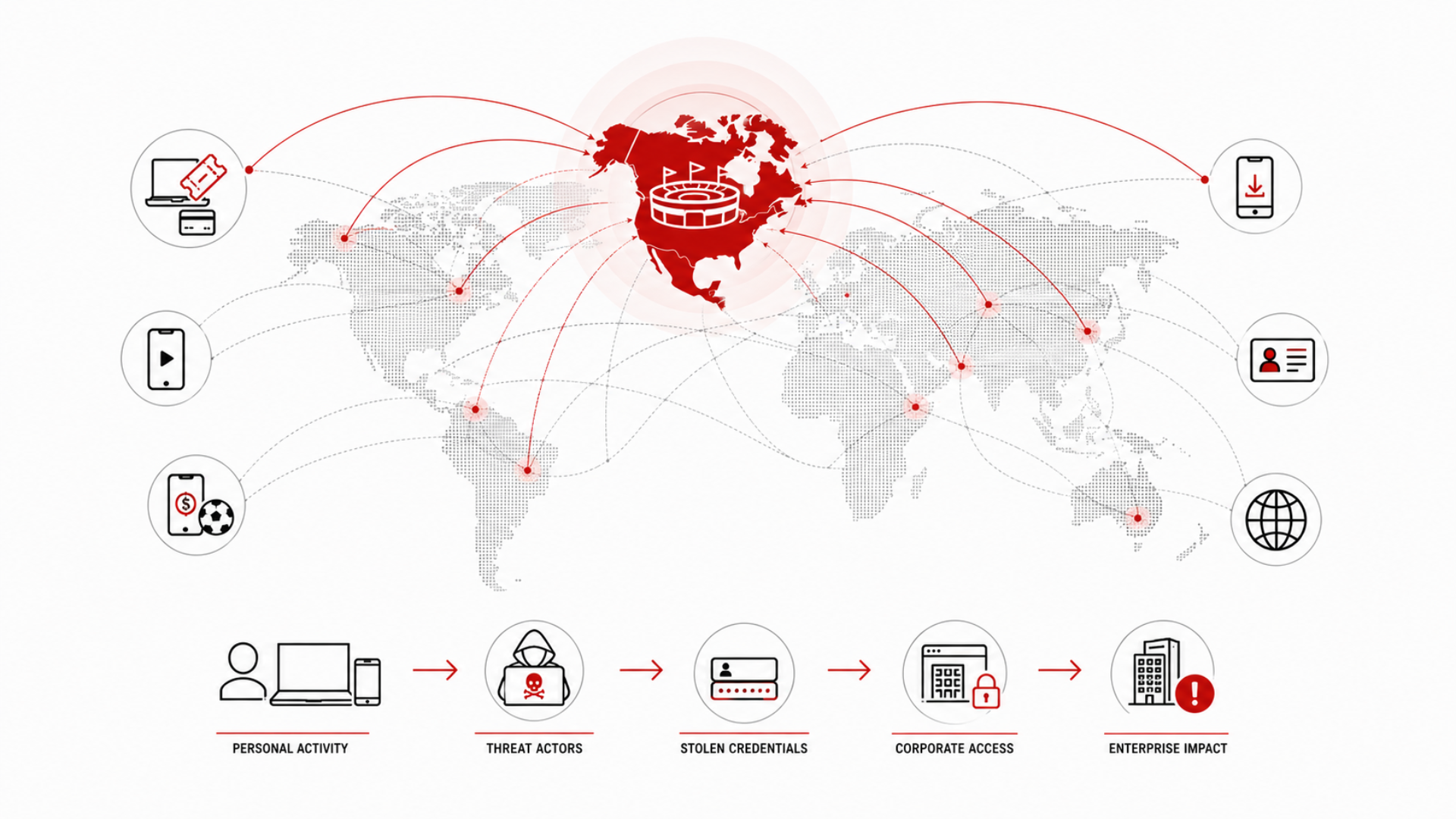
Credential reuse from personal devices. Employees victimized by World Cup phishing on personal devices routinely reuse those passwords on corporate SaaS systems weeks later. This is the most documented enterprise entry point from mega-event fraud campaigns.
(Source: Unit 42, Penligent threat analysis June 2026)
DDoS against critical infrastructure. CISA Advisory AA26-097A confirmed Iranian-affiliated actors are actively exploiting internet-exposed PLCs across US Government Services, Water and Wastewater, and Energy sectors as of April 2026. NoName057(16) demonstrated DDoS capability against the Milano Cortina 2026 Winter Olympics in February 2026.
AI-powered impersonation. 37% of phishing emails targeting sports sector customers in the October 2025 to March 2026 window contained novel social engineering features, up from 32% the prior year. AI-generated content referencing real fixtures, venues, and executives is now operationally standard. (Source: Darktrace Annual Threat Report 2026)
Why your geography is not your protection
The tournament is in America. The threat surface is global.
Every enterprise on the planet with employees has people booking tickets, searching for streams, and downloading betting apps during the 39-day window. Every credential harvested on a personal device anywhere in the world is a potential corporate account takeover weeks later.
Every enterprise with a vendor, contractor, or client connected to the North American event supply chain is inside the same risk pool. The Asian Football Confederation breach in April 2026 exposed 150,000+ passport IDs and contracts covering football entities across Asia, the Middle East, Africa, and Europe. Those records are already in dark web marketplaces.
Palo Alto Networks issued Asia-Pacific specific warnings. The Canadian Centre for Cyber Security issued formal advisories for North American organizations. Darktrace’s sports sector survey covered professionals in the US, UK, Australia, and Germany. Every major intelligence agency treating this as a global event is doing so because it is one.
Eight controls before July 19
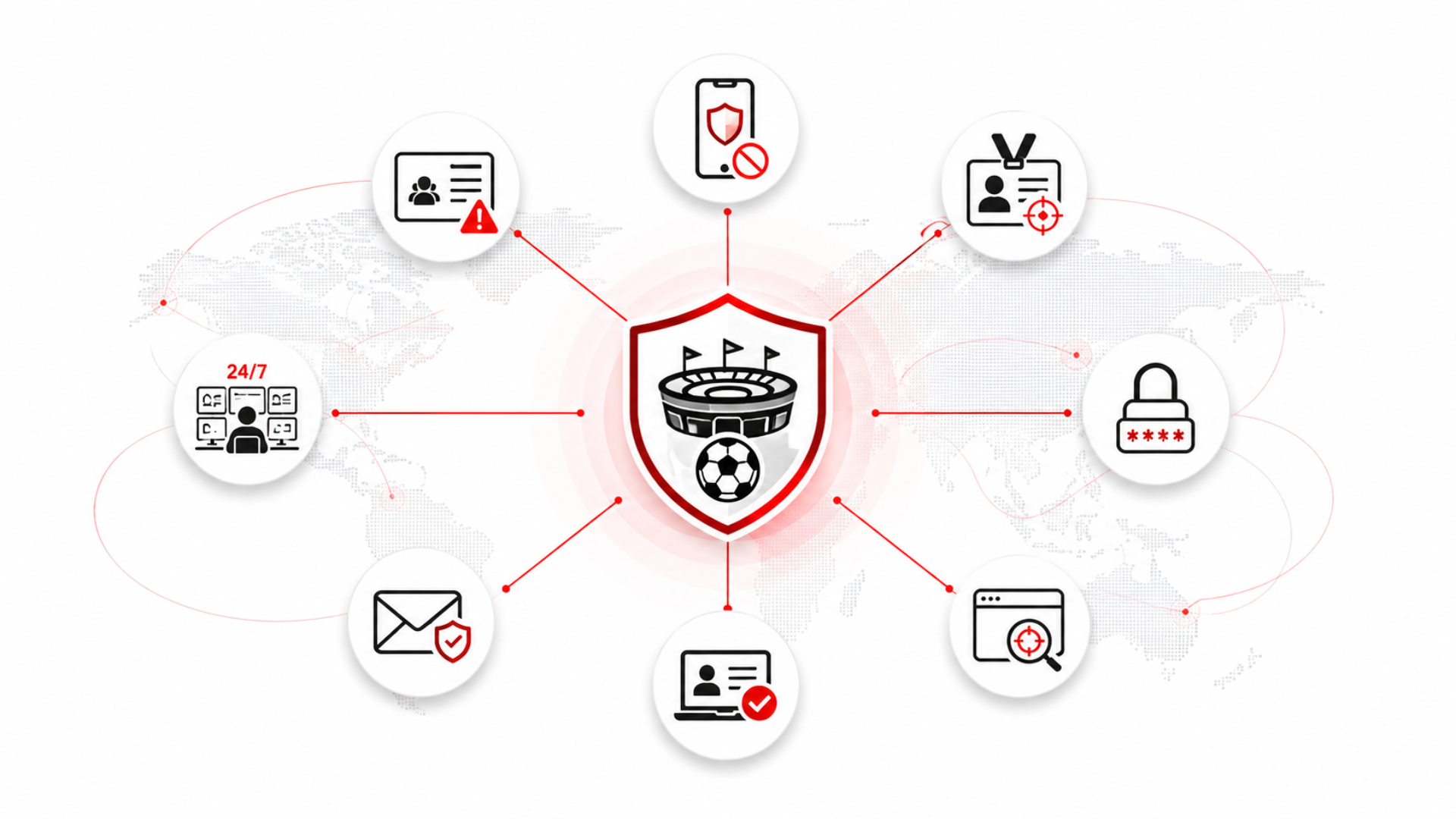
- Block sideloaded APKs on managed devices. Unofficial streaming, betting, and ticketing apps are confirmed infostealer vectors per FortiGuard Labs June 2026.
- Issue a World Cup phishing advisory to finance, HR, marketing, and executive teams. Darktrace confirmed VIPs receive 21% of all sports-sector phishing. These are your highest-risk users.
- Audit every third-party vendor with privileged access. The supply chain is the attack surface. Unit 42 identified IT service providers as the primary breach vector at Pyeongchang 2018.
- Enforce MFA on all corporate accounts without exception. CISA AA26-097A confirms most mega-event intrusions begin with credentials, not exploits.
- Set up lookalike domain monitoring for your brand and key vendors. Recorded Future tracked 1,100+ suspicious World Cup domains since April 2026 alone.
- Run a dark web credential check. KELA confirmed 1.5 million+ compromised credentials already circulating. Find yours before attackers use them.
- Move DMARC to p=reject. Darktrace confirmed 84% of sports-sector phishing emails pass DMARC authentication. If your policy is at p=none, spoofing your domain is trivial.
- Get 24/7 SOC coverage through the full tournament window. The 2018 Olympic Destroyer wiper detonated five minutes into the opening ceremony. Attacks are timed to moments of maximum distraction. (Source: Recorded Future, Unit 42)
This Is Exactly When You Need a 24/7 Security Partner
For enterprises without round-the-clock security operations, a match-window attack at 2 AM IST, 11 PM GST, or 3 AM AEST is a structural vulnerability. The World Cup runs 39 days across four time zones. Your 9-to-6 team cannot cover it.
A Fortinet Engage Advocate Partner MSSP gives you FortiGuard Labs’ real-time FIFA-specific threat intelligence, 24/7 SOC coverage across every time zone your enterprise operates in, and incident response capacity that is ready before the attack happens.
Madre Janus is monitoring. Is your team?
Talk to us about 24/7 SOC coverage
Frequently asked questions
What are the biggest FIFA World Cup 2026 cyber threats?
Phishing via 13,000+ confirmed malicious domains (FortiGuard Labs), QR code fraud, credential theft via infostealer malware, DDoS by Iran and Russia-linked hacktivist groups confirmed by CISA and Europol, and AI-generated impersonation with no detectable tells. All active globally, not just in host countries.
Why are FIFA World Cup 2026 cyber threats a global risk?
Because the attack vectors do not require physical proximity to the tournament. Credential phishing, fake streaming apps, QR code fraud, and supply chain attacks target employees and organizations worldwide. The Asian Football Confederation breach in April 2026 exposed data from entities across four continents.
Which hacktivist groups are verified as active threats at FIFA World Cup 2026?
Handala Hack Team, attributed by Check Point Research, Microsoft, CrowdStrike, the FBI, and MITRE ATT&CK to Iran’s MOIS. CyberAv3ngers, formally attributed to Iran’s IRGC-CEC by six US agencies in CISA AA26-097A. NoName057(16), subject of a Europol takedown operation in July 2025 and confirmed active against the Milano Cortina 2026 Winter Olympics. All three have demonstrated active operations in 2026.
Is FIFA World Cup 2026 really the biggest cyber attack surface ever?
Yes. Palo Alto Networks Unit 42 formally named it the largest global entertainment attack surface in history in their June 2026 threat report. Three nations, 16 cities, 6.5 million in-venue spectators, a broadcast audience approaching half the planet, active geopolitical conflicts, and an AI-amplified fraud ecosystem confirmed active in every major market.
What is QR code fraud at FIFA 2026 and how widespread is it?
QR code phishing involves fake codes for shuttle passes, parking, or match entry that redirect to credential-harvesting sites. Darktrace recorded a 28% increase in QR code phishing globally in 2025, reaching 1.2 million attacks. The Canadian Centre for Cyber Security identified it as the fastest-growing threat variant at the tournament in their June 3, 2026 bulletin.
What should enterprises do right now about FIFA World Cup 2026 cyber threats?
The eight priority controls are: block sideloaded APKs, issue employee advisories, audit vendor access, enforce MFA without exception, set up lookalike domain monitoring, run a dark web credential check, move DMARC to p=reject, and engage 24/7 SOC coverage. All eight are grounded in verified threat intelligence from CISA, FortiGuard Labs, Darktrace, and Recorded Future published in June 2026.